Welcome to my genealogy blog. Ancestors I Wish I Knew is a combination of genealogical information and stories about individuals in my family tree. The focus is on those from my Cochrane, Eitelbach, Merrett, Minarcik and Richards lines and their descendants.

Showing posts with label Eitelbach. Show all posts

Wednesday, October 23, 2019

#202--Driving the REO


I found this picture among my mother’s things.  What a wonderful scene of a family going for a Sunday afternoon ride.  I could identify my grandfather, Walter Eitelbach,  driving, my grandmother, Regina, in the back seat and my mother, Marie,  peaking out the side.  I do not know who the other couple is, but I think they may be one of my grandfather's brothers and his wife.  

I was curious about the car.  There was no identifying information on it, except for the license plate with a date of 1914. I am fortunate to volunteer at Greenfield Village and we have an old car festival.  So I took my picture to the section where the 1910 to 1920 cars were displayed and asked if anyone could identify the car.  Several

gentlemen were very interested and had a pretty intense discussion about what it was and why.  The consensus was that the car was a REO. 

I had no idea what a REO was but with a little research, this is what I learned.  In 1904 Ransom Olds started the REO MotorCompany,  which by 1907 was one of the top four car companies in the United States. The company manufactured cars in Flint, Michigan until 1936 when the depression affect the company so much that it ceased to operate. 


I would love to talk to my grandfather about the
car.  Why he  purchased it?  What it was like to drive?  Where they went?


Friday, August 2, 2019

#190-- Four Brothers in the Jewelry Business


The theme for this week’s blog is brothers. I was really excited.  My great grandparents, Louis and Maria Eitelbach has six children—all boys.  They lived in Hagen, Germany until 1896 when they, along with their four youngest children—Walter, Louis, Maxmillian and William—came to the United States.  They settled in Brooklyn, New York at 1287 Greene Street.  After their arrival, Maria had two more children—Harry and Frank.

Four of the brothers—Walter, Louis, Harry, and Frank-- went into the jewelry business in New York City.  Under the name of Eitelbach Brothers, they designed, manufactured, and sold fine jewelry.  I am not sure, but I believe that Louis designed the jewelry, Harry and Frank manufactured it and Walter sold it.  I remember going to 2 West 47th Street, New York City right off Fifth Avenue and seeing them make jewelry.


The other two brothers took different paths.  Maxmillian went into the mortgage business and became assistant manager of the New York Title and Mortgage Company.  There is little information about William, however, in the census, he describes his occupation once as a machinist and another time as a jewelry manufacturer.


I really wish I had talked to my grandfather about the jewelry business.  I also wish I had been able to spend time with my uncles.


Monday, May 6, 2019

#179--Baking with Nana


The genealogy theme for this week is nurture.  When I looked up the definition of nurture, I found things like to take care of, feed, or protect.  The word feed struck me and reminded me of my material grandmother (Nana), Regina Minarcik Eitelbach.  She was an amazing cook and often had her family for Sunday dinner.  That dinner might consist of a roasted chicken or pork loin, two vegetables, potatoes, and a cake and pie for dessert.

Nana was best known for her baking.  She could bake anything—all kinds of cakes and pies.  I remember her lemon meringue pie had a wonderful flaky crust, a nice lemony filling and a lot of meringue.  When I was little, sometimes I went to visit Nana.  We would go to the park, grocery shop, and visit a five and dime type place, called Lewis of Woodhaven. Sometimes she came to visit us.  Often, she and I would bake.  Usually we baked cupcakes.  My favorite part was to frost them in a rainbow of colors—pink, blue, green, yellow.

Unfortunately, Nana died before she could really teach me how to bake.  However, my mother had a notebook of Nana’s recipes, which I now have.  Some of the recipes are easy to follow and others are not.  I have no idea how much butter is the size of an egg or how much more flour to add to a cup so that it “feels right.”  Here is the recipe for those cupcakes which is pretty clear.

Nana’s Cupcakes
¼ pound of butter
1 cup of sugar
3 eggs
2 full cups of Presto flour
¼ cup milk
tsp of vanilla
Cream the butter and sugar
Add the eggs, milk, and vanilla
 and then slowly add the flour
Frost with confection sugar  and butter

There is no oven temperature listed, but I think 350 degrees for about 20 minutes would be good.

I really wish I could talk to Nana about baking.  How she learned, what her favorite recipes were, did she ever bake something that failed?

Tuesday, April 23, 2019

#177 At Worship


This week’s theme is at worship.  I previous blogged about John Elliott, Apostle to the Indians (see the link on the right) so I needed another idea.  Several years ago, I visited Koblenz, Germany, where in the early1800’s my 4th great grandparents, Heinrich and Christinae (Brucker) Eitelbach lived.

What I know about them comes from the Family Search website.    Heinrich was born on February 6, 1807 and Christina, in 1811.  They were married on February 10, 1834 at the LIEBFRAUEN KATHOLISCH (Church of Our Dear Lady)  in Koblenz and their 5 children:  Catharina Eitelbach (1834 – unknown); Nicolaus Joseph Eitelbach (1835 –unknown); Petrus Eitelbach (1836 – unknown); Margaretha Petronella Eitelbach (1838 –unknown) and Joannes Adamus Eitelbach (1839 –unknown) were baptized in that church.

Here are some of the pictures that I took of the church.

Main Aisle


Altar where they may have been married
Altar detail


Baptismal Fount
Fount Detail


Statue of Our Lady


Tower

I would like to talk to Henrich and Christina about there experiences with the church.  Did they attend every Sunday?  What was their wedding like?  


Monday, March 25, 2019

#173--In the Paper--Divorce Confusion


The theme for this week’s challenge is “In the Paper.”  I love old newspapers.  There is a tremendous amount of information in them.  The advertisements can tell you which stores are having a sale, how much eggs or a loaf of bread costs, and if you look at the pictures, what kind of clothes were in fashion.  The social columns are a wealth of information.  In the Butler Daily Times, I learned that
my grandfather was home from school  and that my Great Aunt Lottie and her nieces were visiting her relatives  In essence, newspapers cover the daily life of the people and places where they lived as well as more unusual events.


I previously wrote about two unusual events that I found in the Butler Daily Times: the  Goose Saloon and about an incident at the Palace Hotel.  So this time I looked for another article and found one in the Brooklyn Daily Star for February 26, 1930.  The article involves two brothers, Harry Eitelbach and Frank Eitelbach.  They were similar in many ways.  Both were jewelers, both lived in Queens, New York, and both married women named Ethel.  They were different in that Harry’s wife, Ethel, wanted a divorce.  The newspapers described what happened:
I blogged about a gun fight at the

.


I would like to talk to both Ethels.  I would like to know what Frank and his wife told the neighbors about the situation.  I would also like to know from Harry's wife, what led to the divorce and how it affected their lives.

Tuesday, March 19, 2019

#172--#12--Louis Eitelbach

Louis Eitelbach


     The theme for this week is #12.  If you look at a family tree and start with you, the 12th person listed is your maternal great grandfather. Louis Eitelbach is my great grandfather on my mother's side.   So, he is the focus of this blog.  Louis was born in Hagen Hamm, Germany in July 1864, one of seven children of Nicholaus Augustus and Helena (Agatz) Eitelbach.  In 1885 he married Maria Berta Huelster.  While in Germany they had four children:  Walter, Louis, Maxmillian and William.

     On May 25, 1895 Louis arrived in New York with his wife and four children.  They sailed from Antwerp on the Red Line ship, Rhyland.  According to the ship manifest, their destination was Brooklyn, New York.  Louis age was listed as thirty and his occupation as a locksmith.  

Louis and his sons
The 1900 census indicates that they were living at 1287 Greene Street, Brooklyn and two additional boys, Harry and Frank, had been added to the family.   By 1910 the family had moved to 152 Napier Street, Queens, New York and in 1920 lived at 8766 109th Street, Richmond Hill, Queens, New York.  While it appears that the family had moved, actually Napier Street was renamed 109th Street.    In all three censuses his occupation is given as a machinist in a tool shop.   The 1920 census indicates that he had filed for naturalization.  I have not been able to find those records.  


Louis died on December 26, 1926.
Louis with my mother

Sunday, July 22, 2018

# 137 New York, New York


Music, the theme for this week, had me stumped for a long time, until I read Amy Johnson Crow’s suggestion that a song might be appropriate.  That made me think of the lyrics from On the Town,   which begins as follows:

New York, New York
New York, New York
New York, New York
It's a wonderful town!

Evidently many of my ancestors thought that New York was a wonderful town because that is where they settled.

Willett Street
The first to come to New York were my great great grandparents, Joseph Munarzik, his wife Regina Wendel, and his children.  They arrived in New York in 1854.  As far as I can tell, they lived on the lower east side of Manhattan in the 17th District.  Interestingly, Regina Wendel’s parents came on the same ship and also lived on the lower east side.  After Joseph and his wife died, their children lived in the same house as the Wendels, 67 Willett Street, Manhattan,  New York.

Next to arrive from Europe were my great grandparents, Louis and Marie (Huelster) Eitelbach with four of their children.  They came in 1896 and originally lived at 1287 Greene Street, Brooklyn, New York, USA.  By 1912 they had moved to Queens, New York at 141 Napier.  Later on, the family lived in Hempstead and Richmond Hill, both in Queens

I have other ancestors, who originally lived somewhere else, and moved to Brooklyn.  William Cochrane, my great great grandfather, and his wife, Emma Merrett originally came from London, England in about 1835, settled in Buffalo, New York, and then in about 1840 moved to Brooklyn with their five children. They always lived at 124 Fort Greene Place.

Park Slope Brooklyn
The last to arrive in New York was my great great grandfather, Abiathar Richards.  He was born in Dedham, Massachusetts in 1837, lived while a boy with his Aunt Lavinia Richards and her husband, Seth Richards, in Newport, New Hampshire, and by 1860 he had moved to Brookklyn, New York to live with this brother, Abner Richards. In 1866 he married Mary Jane Cochrane, daughter of William Cochrane.  They moved into 124 Fort Greene Place and lived there until Abiathar’s death in 1905.  At that time his wife, Mary Jane, moved in with her daughter Gertrude, and her son-in-law, William D. Hannah.  Gertrude and William D. Hannah met in Auburn, New York while she was visiting her cousin, Lucy Pingree, fell in love, married in 1902 and shortly thereafter moved to Park Slope, Brooklyn.

I would like to be able to ask each of these families why they settled where they did and what their lives were like there.  

Friday, May 18, 2018

#128 My Oma, Speaking German


When I think of an ancestor that spoke a foreign language, I think of my Oma, my great grandmother, Maria Huelster Eitelbach.  She was as born in Schmallenberg, Germany in 1865  and came to the United States in 1895 with her husband, Louis Eitelbach and four of their sons.  When I think of Oma and when she spoke German, I remember two things.

First, both my mother and my father had studied German in school and were able to speak it, how well they were actually able to do that, I am not sure.  However, I do remember that when we would go to visit Oma, sometimes they would talk to each other in German.  I think all of them enjoyed doing that.

Second, I remember that Oma would come for Christmas Eve.  After diner, my mother would play Christmas carols.  One that she played was O Christmas Tree (O Tannenbaum), and Oma would always sing it for us in German.

If I could talk to Oma, I would ask if she spoke German with other of her relatives or friends.  I would also like to know how hard it was for her to learn English, which she spoke very well.

Sunday, May 13, 2018

#127 Mother's Day


It should be no surprise that the theme for this week is Mother's Day.  I have two other blogs on this theme: Happy Mother's Day and Happy Mother's Day Maria Huelster so it was time to figure out what to do now.  I have lots and lots of mothers in my tree, but somehow blogging about them was not what I wanted to do.  When I think about mothers, I think about my mother and my grandmothers so I wanted to focus on them.  Also wanted to be able to use  pictures and was delighted that I could find some taken when I was a baby.

Here is one of me and my mother in Prospect Park.


 Next is my Nana, Regina Minarcik Eitelbach, holding me.


 Here is my Granny, Gertrude Richards Hannah, also holding me.


My great grandmother Oma, Maria Huelster Eitelbach also would come to visit,and here she is with me on her lap.


And last here is one of my Oma, Nana, my Mother and me.  I just love their hats.


What an amazing group of women.  I was so fortunately to have them in my life and miss them every day.

Tuesday, January 30, 2018

#114--Were the Eitelbachs in the Census or Not?


What did you find that was interesting in the census is the theme for this week.  However,   I decided to take different tack on that and blog about who I initially could not find in the census.

The census is a wealth of information.  You can learn who lived in the house, how old people were, their occupations, etc.  For the 1930 census you can even learn if they had a radio. However, learning all that depends on being able to actually find the person or people you are looking for in the census.  It should be relatively easy these days.  Both Ancestry and Family Search have searchable indices,
which should identify people who match your search criteria.  That, of course, all depends on the person being accurately listed in the census and transcribed into the index. 

My grandparents’ last name was Eitelbach, a good German name and unfortunately for me one that can be misspelled or mistranscibed in many different ways.  As I began to gather together census information for them, I found my grandfather, Walter, living with his parents in the 1900 census.  He married in 1908 so he and his wife should have been in the 1910 census.  No such luck—no Walter or Regina Eitelbach.  With a little creativity  I found them—Walter and Regina Citelbach, victims of handwriting extending into the line above.  It did not get any better in the 1920 census.  Now they were the Latelbaths.  In the 1930 census, the name was spelled correctly, and made my life easy.  By 1940, they were the Bitebachs

When I could not find them, what did I do?  I changed my search criteria.  I used first names only, years born, where I thought they lived, etc.  For the 1940 census, I knew who lived next door so I
search for that family. 

If I could talk to them, I would be interested to hear how much difficulty the spelling of their name caused them.  Was it generally a problem or just in the census? 

Friday, January 26, 2018

#113--Sunday Dinner at Nana's


This week’s Challenge theme is dinner.  So many ways to go with this.  I considered blogging about a person I would like to invite to diner-- that would give me a chance to ask a lot of questions and fill in some blank spots.  However, since the person would not be there, I would get no answers.  Then, I thought about Sunday dinners.  Dinner on Sunday with your family seems to be a tradition that no longer exists.  But it did when I was growing up, so I decided to write about Sunday dinners.

When I was a child, every Sunday we had dinner with my grandmother, Regina Eitelbach.  Nana lived about 30 minutes away so we drove and spent the day.  I did not realize it at the time, but she was an outstanding cook.  Anything Nana made was always delicious. She always made a full meal and served it on her best china.  I remember my father carving the meat, the bowls of vegetables and potatoes on the table.  However, what I remember best is dessert.    Nana’s deserts were the highlight of the meal--apple pie, lemon meringue pie, chocolate layer cake with chocolate frosting, shadow layer cake, and yellow cake with coconut frosting.  At Christmas, Nana made butter cookies with a cookie press, rolled and frosted cookies as well as German leubkeuken. 

Sometimes when I visited, Nana and I would bake, usually cupcakes.  I loved to frost those cupcakes in all kinds of colored frosting.  The blues ones were my favorites, and I thought tasted the best. I have some of her recipes, but I have not been too successful in making them.  While I know that butter the size of an egg is a quarter of a cup, 2 cups of flour and enough more so it feels right is beyond me.  I have no idea what it should feel like.  Unfortunately Nana died before I was really old enough for her to teach me how to bake. 

I would love to talk to Nana again.  I would ask her how she learned to cook and bake, and what some of her favorite recipes were.  I think I also would ask for a lesson on baking.

Saturday, January 13, 2018

#111--Louis Eitelbach--I Think I Will Have a Beer


The 52 Ancestors challenge for this week is a favorite picture.  Now those of you who know me know that I love old pictures and that I have a lot of them.   In fact, I have blogged about several of them before and this is one of my favorites.  So my problem for this challenge was to pick just one picture. 

I went through a box of pictures that I inherited from my grandfather.  This picture of my great grandfather, Louis Eitelbach, was the one that I finally selected.  What a fun picture.  There he is, all dressed up and sitting on a keg of beer! I love that he wearing a bow tie, pocket watch with chain, and what looks like a flower in his label.

I have no idea where or why the picture was taken.  I do know, however, that there was a large number of Germans living in Brooklyn, where Louis and his family lived and that they had a variety of clubs and activities.  I assume that this picture was taken at one of them. For more information about Louis, see my previous blog post:    The Picture on My Wall.

If I could talk to Louis, I would want to know where the picture was taken and what was happening.  

Saturday, February 11, 2017

#99 Organizing the Minarciks, Eitelbachs, Hannah, and Richards—A Follow-Up


It has been an incredibly busy January and somehow this blog was put on the back burner. I did, however, think about my genealogy goals for last year. One of those goals was to organize all the documents that I have for my various lines. As I previously blogged, I decided that the best way for me to do that was to use the loose leaf notebook method. Each line has its own color-coded notebook, which is divided into sections for each person. The first document in each notebook is a chart that contains the ancestors who are in the notebook. After some experimentation, I decided to start with the most recent ancestor and work my way back.

So how did I do?  Pretty well.  My four main direct lines—Minarcik, Eitelbach, Hannah, and Richards were completed.  I now have birth, marriage and death information for each person along with other information that is unique to that person, e.g. pension records, land records, etc. A great deal of what I had was online so I did a lot of printing.  I also had to do some searching as I discovered that I was missing some of the information I wanted for some people.  Each document is in its own clear plastic holder.

Having gotten those lines done, I then turned to the collateral lines:  I completed the Cochrane line and most of the Mears.  I am now working the Newells.

This procedure was not with some problems.  One of the problems that I ran into while looking for a particular record was getting distracted and going off in another direction.  I found some interesting information while doing that, but it certainly did slow the process down.  Another problem was ending up reading all the information I had.  That was a plus and a minus.  I learned more, but got slowed down.

So what is up for this year?  I want to get the rest of the lines organized.  I also have a very, very large number of pictures.  I want to go through them and decide which ones to keep, which ones to scan, and which to discard. Tune in next year and see how I did.

Thursday, November 10, 2016

#94--From There to Here--The Richards, Hannahs, Minarciks and Eitelbachs Arrive


I recently flew to and from Europe.  It took about 8 hours to get to Spain and about 10 hours to fly back from Rome.  During those flights, I thought about my ancestors who came to America and what they may have experienced.  They arrived along before airplanes crossed the ocean so I decided to go back and look at the ships that they took to get here.  I also decided to focus on my four main lines—Richards, Hannah, Eitelbach and Minarcik.

Edward Richards is my earliest immigrant ancestor.  According to Cutter in “New England Families, Genealogical and Memorial, V. 2., Edward Richards came from England about 1632.  While not listed on the ship manifest, he is presumed to have come on the Lyon with his brother Nathaniel.  The Lyon sailed from London on June 22 and arrived in Boston on September 16.  While they were on the ship for 12 weeks, for only 8 of those weeks were they at sea.

James Hannah is my next immigrant ancestor to arrive.  However, I have not been able to figure out exactly where or when he landed.  I do, however, have some idea of when he might have immigrated. The earliest document that I am able to locate is an 1806 application for a land warrant in Armstrong Count, in which James swears that he and his family settled on the land in 1799, built two cabins, cleared the land and planted crops.  Andrew Mckee, his father-in-law, and Phillip Anthony both swore that James Hannah had lived there for at least five years.  Further, his oldest child, James Hannah, consistently states that he was born in 1795.  So my best guess is that James landed in the Philadelphia area some time before 1795, married Nancy McKee and along with his father-in-law and his family moved to Armstrong County.  At that time, it took 7 to 8 weeks to cross the Atlantic.

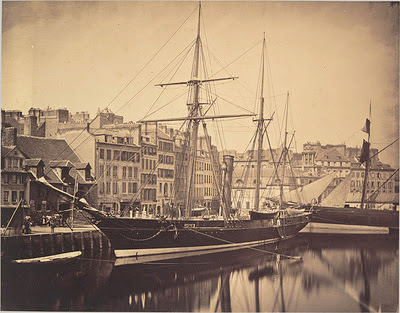
.Le Havre in the 1850's
My third group of ancestor were the Minarciks.  On June 27, 1854  Joseph Munarzick with his wife, Regina and two children—Elizabeth and Carl—arrived in the port of New York.  They sailed from LeHavre, France on the ship William Tell, a 3-masted, square-rigged sailing ship on May 21.  The
William Tell arrived in New York on June 27.  The voyage lasted 38 days. According to the ship manifest, there were 618 passangers on board along with cargo.  Interestingly, Regina Munarizick’s parents, John and Catherine Wende along with their children—Marie, Catherine, Carol, Susan and John—were on the same ship.

Rhyland
The last to arrive there the Eitelbachs.  They sailed on the Red Star Line’s Rhynland, a four-masted steam ship.  While I cannot pin down exactly when they left Antwerp, they arrived in New York on May 23, 1895.  The Red Star Lines’ web page indicates that the voyage typically  took from 7 to 10 days, so they should have left sometime between  May 13 to 16.  Looking at the passenger list, I learned that they came third class or steerage, their quarters were in the stern of the ship and they brought 5 pieces of luggage with them.  I also saw that Louis described himself as a locksmith.

So over the course of about 400 years, the amount of time it took to travel from Europe to the United States dropped from 8 weeks for Edward Richards to 38 days for the Minarciks, to 7 to 10 days for the Eitelbachs to my 10 hours.  I know what my trip was like, I would like to know more about theirs.