Welcome to my genealogy blog. Ancestors I Wish I Knew is a combination of genealogical information and stories about individuals in my family tree. The focus is on those from my Cochrane, Eitelbach, Merrett, Minarcik and Richards lines and their descendants.

Showing posts with label Richards. Show all posts

Wednesday, November 13, 2019

#204 Rich Man


.
There are many ways to be rich.  My emigrant ancestor, Edward Richards (1610-1684) was a rich man.  When you are dealing with people in the 17th century, it is hard to determine exactly how rich any one was.  One way to determine that is to look at what they owned, particularly land.


Edward Richards lived in Dedham, Massachusetts.  He arrived there about 1632 and was granted a house lot and another lot because there was a defect in his house lot.  A little later he was able to buy an additional lot from Robert Feak.  Edward joined the church and signed the Dedham Covenant.


The town of Dedham was granted a good deal of land, some of which they held and other of which they distributed to its residents.  They had an interesting system.  The amount of land a person received was based on the amount of land the person already held and the number of people in the family.  So if you had a lot of land and a large family you got more land than people who owned less land and a smaller family.

Edward received land on 14 separate occasions.  In 1642 he was given 4 acres for improvement and two years later received 5 acres.  Typically, he was granted more land than the vast majority of individuals.  In 1657-8 when a cedar swamp was divided, Edward received the second larges grant, only the  Reverend Allin received more.  Another way to determine his wealth is to look at the taxes he paid.  Generally, he was in the top three or four men in terms of the the amount he was assessed.

Within the land granted to Dedham was a large tract of land which previous had been granted to a Mr. Cook of Dublin, Ireland for a large farm and manor house.  After Mr. Cook died, his attorney was given permission to sell the lands to Eliazer Lusher and Anthony Fisher of Dedham.  Some time later, Edward Richards was able to buy Mr. Cook’s farm and built “Broad Oaks,” which remained in the Richards family until 1838.


So I think, in terms of land Edward Richards was a rich man.  If I could talk to him, I would like to know what he did with all that land.  How much was farmed? How much was meadow? How many buildings was on that land?

Thursday, July 4, 2019

#187--Another Brother Fighting for Freedom--John Richards


The Fourth of July is this week so when the theme was Independence I immediately though of those in my family who fought in the Revolutionary War.  I have previous blogged about my third and fourth grandfathers, Abiathar Richards, Sr. and Abiathar Richards, Jr. and their brother, Abel Richards—all who fought for freedom.  Now I am going to add another brother to that list, my uncle, John Richards. 


John Richards was born in Dedham Massachusetts on March 19, 1723.  His parents were John and Abigail (Avery) Richards.  He married Rebecca Herring.  They had two sons and six daughters.
John’s service was fairly brief, but not unusually so.  Massachusetts Soldiers and Sailors in the Revolutionary War Indicated John was a private in William Ellis’s Company, Colonel Heath’s   He also served in a company commanded by David Fairbanks, Colonel McIntosh’s Regiment for 4 days at Dorchester Heights.  According to the website Boston’s Revolutionary War
Regiment which marched o
n the alarm of April 19, 1775 and served 9 days.

“In the evening of March 4, 1776, George Washington's army and local volunteers quietly fortified the summit of Dorchester Heights with cannon captured at Fort Ticonderoga. When the British army in Boston woke the next morning, they discovered that they were now surrounded. This action by the colonial militia hastened the decision by the British army to evacuate Boston nearly 2 weeks later.”


I would like to talk to John about his service.  Just what did he do?   Were any of his brothers or other relatives serving in the same units?  How hard was it to maneuver the cannon into place?

Friday, May 17, 2019

#181--Abiathar Richards, Jr.--Fighting for Freedom


Several years ago I blogged about  Abiathar Richards, Sr. and his role in the Revolutionary War.  However, he was not the only person in that household that fought for freedom.  His oldest son, Abiathar Richards, Jr. also served briefly.  Abiathar, Jr. is my 3nd great grandfather and the subject of this week’s blog. whose theme is military.

                Abiathar Richards, Jr. was born on April 7, 1754.  His parents were Abiathar Richards, Sr. and Elizabeth (Richards) Richards.  He married Elizabeth Smith on April 12, 1782.  Abiathar and Elizabeth had eleven children.

                I did not know much about Abiathar, Jr.’s service, but  found in the Massachusetts Soldiers and Sailors in the Revolutionary War,  that Abiathar Richards, Jr. was a Private in Captain Aaron Fuller’s 
Company, which marched on the alarm of April 19, 1775.  The company was from Dedham, Massachusetts and served for 2 day.  That was helpful, but I still did not know that much about what that company actually did.  Fortunately, I was able to find a description of their involvement in Dedham, 1635-1890:  Examples of things past.


          “A little after 9:00 a.m. on the morning of April 19, a rider on an (inevitably) lathered horse galloped down Dedham High Street from the direction of Needham, and reined in at Samuel Dexter’s front gate.  Flinging himself off the horse and rushing up the walk, he met Dexter at his door, spouting forth his message of bloodshed and conflict at Lexington. ..As units or fragments of larger military contingents, Dedham men assembled and march for the scene of the engagement—89 men from the First Parish under Captain Aaron Fuller and George Gould….[At Menotony (now Arlington)] some of the men, joining with units from Needham and Lynn, ranged along a hill on the south side of the road, where they had a clear view of the approach from Lexington, and where they could expect a measure of protection from a stone wall that stretched uphill from the Jason Russell house.  A British flanking party surprised them and drove them back toward the house, trapping them between the flankers and the main body of troops in the road and virtually annihilated them.  Elias Haven of Captain Battle’s Company died there, along with nine men from other towns, (Hanson, p.155).


So now I know a little more about Abiathar, Jr.’s 2 days of service in the Revolutionary War.  Exactly where he was and what he did during the battle at Menotony I do not know.  So if I could talk to him, I would ask them those questions. 

Wednesday, March 6, 2019

#170--My Not Bachelor Uncle


This week’s theme is bachelor uncle.  I looked and looked through my genealogy to find a bachelor uncle and was not successful.  So I decided I would just write about one of my uncle, who is not a bachelor, William Fisher Richards, my great uncle.

He was born in 1879 to Abiathar and Mary Jane (Cochrane) Richards.  Chester Ingersoll Richards  (1867--1940 ) was his brother and Gertrude Richards (1875-1960) was his sister.  I could not find much information about him.  I know , as a child, he was born and lived in Brooklyn, New York and then attended Union College in upstate New York.  From census data, he appears that he returned to Brooklyn and was employed in his father’s shoe business along with his brother, Chester.  He died in 1929 and is buried in Green-Wood Cemetery in Brooklyn, New York. 

While I do not know much about Uncle Bill, I do have some great pictures of him.

The one at the top of the page is of him on the left with this brother, Chester on the right.  It is rather interesting picture.  I cannot figure out if their mother was in the middle and for some reason her head was cut out.  At that time, there was something called a mother's chair, where the mother sat under a black cloth and could hold her children.


Here is the second one.  I am guessing he is about 6 or 7 in this picture.  There are many things I like about his picture. The way his hair is parted, his big eyes, the hat that he is holding in this hands, and the fact that only one of his feet is on the floor.  The chair he is sitting in is pretty impressive, too.  That is a whole lot of fringe on the bottom!


Here he is a little older.  I think this might be a picture taken for his high school or college graduation.  I like his jacket and the ruffles around the collar.


And this one is the only picture I have of him as an adult.  That bow tie is great.


I would love to know more about his life. What he did.Where he traveled. Where he lived.

Monday, February 25, 2019

#169--At the Courthouse--Contesting a Will


Edward Richards, my seventh great grandfather and immigrant ancestor, came to the Massachusetts Bay Colony in about 1634, settle in Dedham, Massachusetts and signed the Dedham Covenant.  He married Susan Hunting.  Edward and Susan had four children:  Nathaniel, John, Sarah, and Mary.  Edward was active in the affairs of Dedham, and acquired a good deal of land.

Edward Richards died May 25, 1682, shortly after dictating his will but before signing it.  He left his wife room in this house, 12 pounds per year to be paid by their sons, Nathaniel and John, and the right to select 40 pounds worth of household goods.  His homestead, Broad Oaks, he left to his second son, Nathaniel, along with lots in Fowl Meadow and on Pond, Poweset, Birch and Great Plains.  To both Nathaniel and John he gave “The remainder of Mr. Cook’s farm.”  He left his daughter, Mary Richards Bullard, 15 pounds, if she was a widow otherwise her husband, Nathaniel, was to receive 5 pounds plus what he had already given him.  John Hearsey, husband of Sary Richards, received 40 pounds plus what he had already given him.  If his son, Nathaniel, was to send a college (“he brought up a son to learning”), Nathaniel should receive an additional 60 pounds toward the expenses.  Susan Hunting died several months after her husband on September 7, 1684.

Nathaniel and John were appointed administrators of Edward’s will.  They also divided Susan share (40 pounds in household goods) according to the custom of the times, two shares to John as the oldest son, and one share each to the other children.  Nathaniel Bullard and John Hearsy provided receipts
for their wives share.  Bullard and Hearsy filed a petition in the Suffolk County Court contesting the will based on their belief that their wives had been wronged.

“His daughters in their young time desired and with their parents free consent lived out at service
&…both married at about 18 yers of age…, but we both John and Nathaniel Richards seeing our father so destitute of help, willing with great care and labor lived with our father and carried on his whole business till we were each of us about 30 years of age before we married,”

The Court after hearing testimony, upheld the will.  Bullard and Hearsey appealed the decision to the Court of Assistants, but again failed to have the will set aside.

Tuesday, November 6, 2018

#153--Abiathar Richards--That is a Great Beard


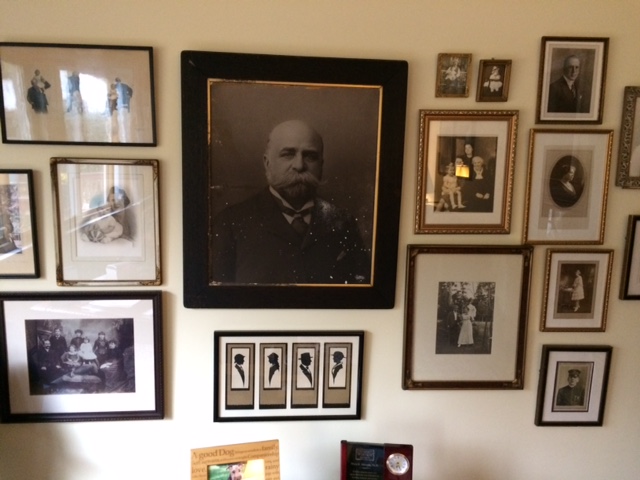
Beards are back in vogue and they are this week’s theme.  When I saw that theme, I immediately knew who I was going to blog about—my great grandfather, Abiathar Richards.  I have a wonderful picture of him which is the centerpiece of my gallery wall.

About thirty years ago, when my great aunt, Henrietta Richards, died, her family called my father and asked if he would like the picture of Abiathar Richards that they had.  My father said yes, thinking that it would be a rather small picture.  Imagine his surprise, when they dropped off a portrait that is about 3 feet tall, and 2 and a half feet wide.

To me he looks like a typical gentleman of the late 1800’s—dress coat, high collar, and tie.  However, his most distinguishing feature is his elegant mustache and beard.

I  knew that I had blogged about Abiathar Richards before, and was interested to see that he was the subject of my first genealogy blog, so if you would like more information about him, click here:  Abiathar Richards. 

Tuesday, October 30, 2018

#152--A Scary Place


Halloween is this week and our genealogy theme is scary.  So what is more scary than a graveyard.  I have visited the graves of lots of my ancestors so I decided to use some of the pictures I had taken there.

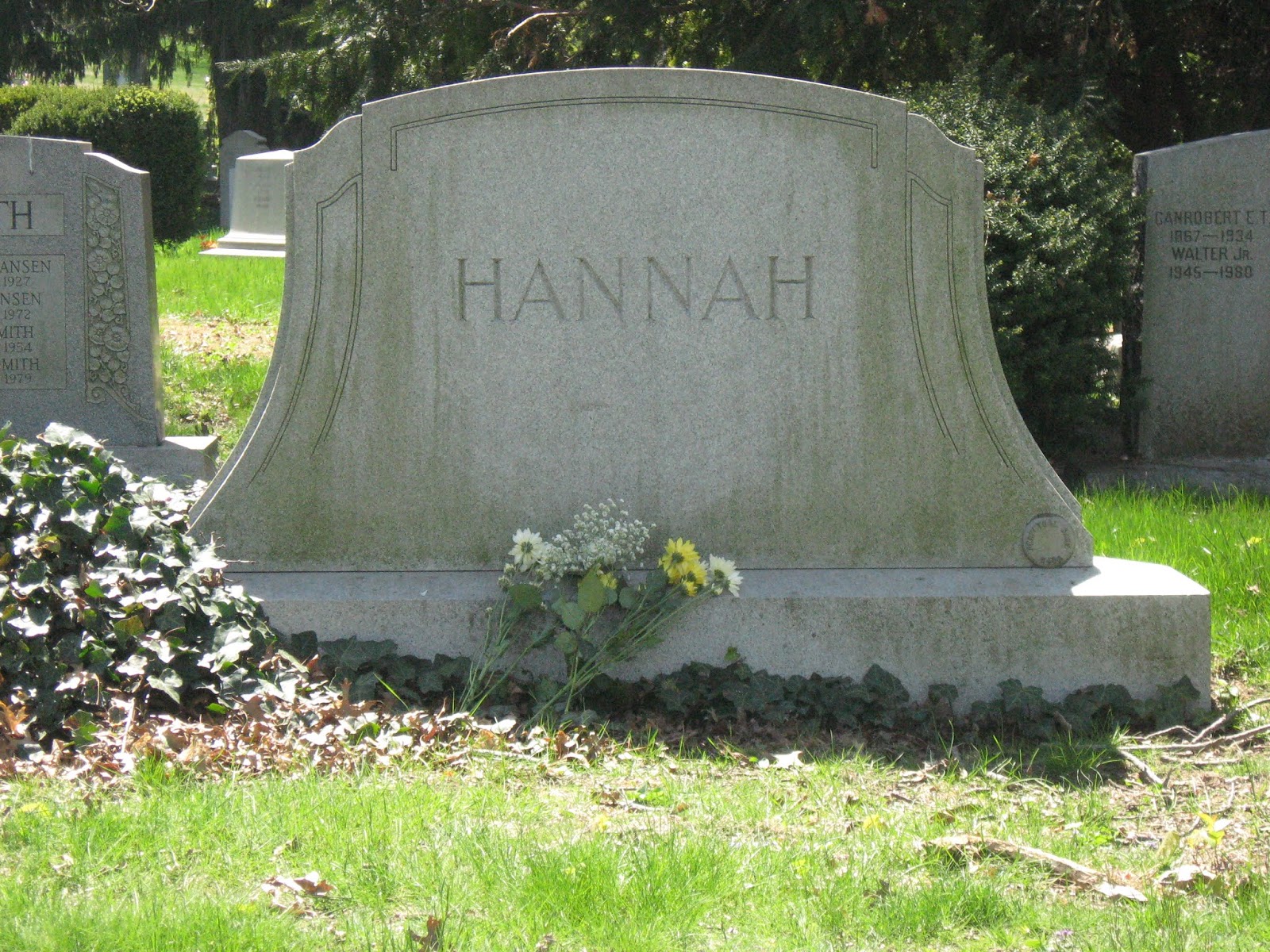
Several years ago I visited Paris Illinois in Edgar County and went to the Hannah plot.  In the plot, I found the graves of my great great grandfather, James M. Hannah, and three of his daughters, Albertine, Mary Sayres, and Catherine.   The oblelisk is for James, and the three smaller headstones are for the daughters.  Albertine Hannah left money in her will for the plot, obelisk and headstones.


The Village Cemetery in Dedham, Massachusetts contains lots graves as well as some very old graves that are not marked.  The first picture is of the very old gravestones—the names on them are very hard to read.  The Richards graves tend to be located close to each other.
Old Gravestones 
Abiathar and Elizabeth Richards


In the row of gravestones to the right, my great great grandparents, Abiathar and Elizabeth Richards have the second and third stones.


Green-Wood Cemetery in Brooklyn is a very large historic cemetery, in fact it is on the list of historic place.  My family actually has three plots in Greenwood—the Cochrane plot, the Hannah plot and the Richards plot.  My grandparents and parents are buried in that lot.  When I was growing up we lived fairly close to the cemetery, so we used to visit often.  We usually visited the Hannah plot first as it is very close to the entrance.  My grandparents and parents are buried in that lot.


Then we might drive over to see the Richards Lot, my great grand parents, Abiathar and Emma (Merrett) Richards are buried there along with my great uncles and their wives.


Until several years ago, I did not know where the Cochrane lot was, but with the help of a very good map of the cemetery, I was able to find it in an older section of the cemetery.  My great grandparents, William and Emma (Merrett) Cochrane as well as several of their children are buried there.  The two little headstones in the front say Father and Mother.  I really like that lot, it is off the beaten path and in a very quiet spot.


I do not necessarily  find cemeteries scary, I just find them very interesting. I wonder about the lives of the people who are buried there, who they were, and what they would think of the world today.  .


Thursday, September 20, 2018

#147--Abiathar Richards, Farming in Dedham, MA.


When I saw the theme for this week’s genealogy blog was farm, I thought “Oh no.”  I have written about a number of farms and farmers in my family:  George Newell, John Hannah, Sarah Hannah.  They were all farming in the mid 1800’s in the Midwest and the Agricultural Census gave me lots of information about them.  However, I also had farmers in my Richards line whose farms were in Dedham, Massachusetts from the mid 1600’s to the 1800’s.  So I decided that I would see what I could gather about one of them.

I looked though what I had and discovered that I had some interesting diary entries and newspaper clippings about my great great great grandfather, Abiathar Richards, Jr.  Abiathar was born in April 7, 1754 to Abiathar and Elizabeth (Richards) Richards.  He married Elizabeth Smith on April 12, 1782.  They had  eleven children.

According to various records, Abiathar Richards was a farmer. . Nathaniel Ames was a physician in Dedham and Ames’s diary contains several references related to farming and cattle. “ May, 14, 1814…Ab’r Richards to Calf to sell..(P 1017)”; “June 13, 1816 Ab Richards calf w 23lb” ; “November 22, 1816 Calf 7 w old Ab Richards good Veal 16 lb. hind qrs sold At 10 cents Lb (p. 1068).  Dr. Ames also indicates that he was paid by Abiathar in produce or livestock for treating various illnesses.


In the local Dedham newspapers I found several ads from Abiathar related to lost or found livestock. On November 4, 1797, Abiathar advertised that he had five stray cattle and that if the owner could identify them and pay Abiathar for taking care of them, he could have them back.  Somehow, Abiathar lost 23 sheep and a 3 year old mare colt who wandered off.


In 1824, Abiathar advertised to sell his farm.  From the ad, it appears that Abiathar primary focus was raising, selling and slaughtering cattle.  It is not clear what he raised in the orchard.


I have several questions for Abiathar.  Where was the farm?  How big was it?  Did you grown crops and if so, what:  Why did you decide to sell it?


Wednesday, September 5, 2018

#144--Shoes--A Family Business


Labor Day is this week so my blog challenge is about work.  I love pretty shoes and that may be because I have a number of relatives who were in the shoe business in New York City in the late 1800’s and early 1900’s.

 So I decided that I would blog about them and see how they fit together.  Early on, the settlers had lots of land in Dedham and were able to pass large tracts of it on to their sons.  However, by the 1800’s fewer and fewer families were able to give away enough land for a sustainable farm.  Consequently, young men began to leave Dedham and seek their livelihood elsewhere.


The first one of my ancestors to leave was Nathaniel  Fisher, one of my cousins.  He moved to Buffalo, New York and worked for John W. Ayes in the shoe business.  In 1837 he started working in New York City, on Pearl Street also in the shoe business of L. S. Bouton & Company as a junior partner.   Nathaniel then went into partnership with Baldwin and Studwell .  In 1869, his two partners left the business and Nathaniel C. Fisher & Company was formed. The company manufactured and sold ladies’ and misses’ boots and shoes.  Prior to Nathaniel Fisher’s death on December 9, 1880, he was joined in his company by two of his sons----Irving  Requa Fisher and Nathaniel Campbell Fisher. Most notable is the clock that he put on the front of his store on Duane Street and it is still there.

The next ancestor to leave Dedham was Abner Richards, my great uncle.  He came to New York City in 1840 and worked as a clerk in his cousin’s, Nathaniel Fisher’s shoe company.  In 1845, Abner began working for J. D. Ingersoll.  When Ingersoll retired in 1853, the company name was changed to Richards and Whiting.


Abiathar Richards, Abner’s brother, came to New York prior to the Civil War.   Abiathar joined his brother’s firm and the name was changed to A. S. Richards Shoe Company, located at 44 Cortland Street, New York, New York, and later on Reade Street.  The tax records indicate that he was shoe auctioneer.   When Abner died in 1887, the name of the company became the A. Richards & Company with Abiathar as the president.  Shoes were sold directly to dealers nationwide with specific men being in charge of certain areas of the company.  In addition, the company also held shoe auctions every Wednesday and Friday.  After Abiathar Richard’s death in 1905, the company was run by his two sons, Chester Richards and William Richards.  The last mention of the company that I can find was in 1919

Monday, August 6, 2018

#139 William Fisher Richards--Oldest Picture


Tintype Camera


Oldest?  Oldest ancestor?  Oldest document?  Oldest brick wall?  Oldest picture?  All were possibilities for this week’s theme, but the one I liked the most was my oldest picture.  I inherited some very old tintypes of my ancestors.

If you have seen tintypes, you may know that the people look very stiff and formal and no one ever smiles.  That is because it took about a minute to get the image onto the iron plate (Yes, they are called tin types, but they are actually on sheets of iron.) and no one can smile for that length of time and not move their mouth.  Any movement will lead to a blurry image.  That is why they are stiff and unsmiling.

This is  William Fisher Richards, my great great uncle. He was born in 1879 so I am guessing he is about 6 or 7 in this picture.  There are many things I like about his picture.  The way his hair is parted, his big eyes, the hat that he is holding in this hands, and the fact that only one of his feet is on the floor.  The chair he is sitting in is pretty impressive, too.  That is a whole lot of fringe on the bottom!

I would love to know where it was taken, what if anything, he remembers about going to the "tintypists," how hard it was not to move, and if he ever wore that hat.

Sunday, July 22, 2018

# 137 New York, New York


Music, the theme for this week, had me stumped for a long time, until I read Amy Johnson Crow’s suggestion that a song might be appropriate.  That made me think of the lyrics from On the Town,   which begins as follows:

New York, New York
New York, New York
New York, New York
It's a wonderful town!

Evidently many of my ancestors thought that New York was a wonderful town because that is where they settled.

Willett Street
The first to come to New York were my great great grandparents, Joseph Munarzik, his wife Regina Wendel, and his children.  They arrived in New York in 1854.  As far as I can tell, they lived on the lower east side of Manhattan in the 17th District.  Interestingly, Regina Wendel’s parents came on the same ship and also lived on the lower east side.  After Joseph and his wife died, their children lived in the same house as the Wendels, 67 Willett Street, Manhattan,  New York.

Next to arrive from Europe were my great grandparents, Louis and Marie (Huelster) Eitelbach with four of their children.  They came in 1896 and originally lived at 1287 Greene Street, Brooklyn, New York, USA.  By 1912 they had moved to Queens, New York at 141 Napier.  Later on, the family lived in Hempstead and Richmond Hill, both in Queens

I have other ancestors, who originally lived somewhere else, and moved to Brooklyn.  William Cochrane, my great great grandfather, and his wife, Emma Merrett originally came from London, England in about 1835, settled in Buffalo, New York, and then in about 1840 moved to Brooklyn with their five children. They always lived at 124 Fort Greene Place.

Park Slope Brooklyn
The last to arrive in New York was my great great grandfather, Abiathar Richards.  He was born in Dedham, Massachusetts in 1837, lived while a boy with his Aunt Lavinia Richards and her husband, Seth Richards, in Newport, New Hampshire, and by 1860 he had moved to Brookklyn, New York to live with this brother, Abner Richards. In 1866 he married Mary Jane Cochrane, daughter of William Cochrane.  They moved into 124 Fort Greene Place and lived there until Abiathar’s death in 1905.  At that time his wife, Mary Jane, moved in with her daughter Gertrude, and her son-in-law, William D. Hannah.  Gertrude and William D. Hannah met in Auburn, New York while she was visiting her cousin, Lucy Pingree, fell in love, married in 1902 and shortly thereafter moved to Park Slope, Brooklyn.

I would like to be able to ask each of these families why they settled where they did and what their lives were like there.  

Monday, June 4, 2018

#130 John Richards--Close in Location, but Far Away in Time


The theme for this week is far away. It could be interpreted in several ways, so I decided that I would interpret it in terms of time and blog about an ancestor who lived a long time ago, Nathaniel Richards, who was born in the 1600’s.  I have previously blogged about his father, Edward Richards and his brother, John Richards.

Nathaniel Richards, the second son of Edward and Susan Hunting Richards was born on January 25, 1648/49 in Dedham, Massachusetts.  On February 21, 1678/79 he married Mary Aldis, daughter of Deacon John and Sarah (Elliot) Aldis.  Nathaniel and Mary had eight children.

Nathaniel first appears in the Dedham Town Records when he received “ten shillings for killing one wolfe” (Vol 5, p.36).  Three years later, Nathaniel along with 21 others was fined 16s 8p for “sitting disorderly in the meeting house (Vol 5, p 72.  In In 1679, he was fined 2 shillings for defects in his highway work.

Nathaniel served in the town of Dedham in several ways.  In 1681/82, and 1882/83, 1685, 1689 he was appointed to view fences.  Both John’s father, Edward, and his brother, John, were fence viewers so I was interested in finding out exactly what this job involved.  After a quick search of the web, I learned that fence viewer is one of the oldest appointed positions in New England.  The viewer’s job was to make sure that fences were maintained properly and to settle disputes over property lines when a person believed that his neighbor’s fence was on his property.  .Nathaniel was also elected constable and collected taxes from the town’s property owners. In 1700 and 1705 he laid out roads.

On several occasions, Nathaniel lent the town money.  In 1690 Nathaniel lent the town 5 pounds to pay Josiah, the Indian.  The town paid the debt by selling land at Dorchester.  Five years later, Nathaniel and his brother, John, lent the town 4 pounds and ten shillings.  In return, they were granted 20 acres of land at a place they both could agree was satisfactory.

Nathaniel died on February 15, 1726-27 “suddenly while sitting in his chair” at the age of 79.  He was buried in the Village Cemetery. His tombstone reads “Here lyes buried the body of Mr. Nathaniel Richards age 78 decd Feb ye 15, 1726/7.

In his will, he gave his wife all his silver money, the use and improvement of all his housing and lands during her life.  He gave land to his sons, Nathaniel, James, Edward, and Jeremiah.  His son Edward received his homestead.  Each of his daughters received 100 pounds.  Whether or not he believed that some of his children would not be pleased with their inheritances I cannot tell, but he did instruct that anyone who objected would be cut out of his will.

I would like to talk to Nathaniel about why he and his brother lent the town money.  Did they offer?  Were they asked?  I also would like to know why Edward inherited the homestead rather than Nathaniel his oldest son?  Of course, I would like to know about just what behavior was considered disorderly in the meeting house.


Tuesday, April 24, 2018

#125--Visiting Green-Wood Cemetery in Brooklyn


Green-Wood Cemetery

When I was growing up, we lived near Green-Wood Cemetery in Brooklyn, New York.  That was in the era when families went for a car ride after Sunday dinner.  We often did that, and one of the places we visited was Green-Wood Cemetery, which was very close to where we lived.  Green-Wood was one of the first “rural” cemeteries, built in the mid 1800’s.  As a rural cemetery, it was constructed with lots of winding roads, trees, bushes, and several lakes.

Richards Lot
Cochrane Lot
We always visited out family plots.  First, we would go to the Hannah plot where my grand-parents were buried.  Often we would then go to the Richards lot.  My father always said you found it by driving down the outer drive of the cemetery, and stopping at the tomb of the vaudeville player with the banjo, parking the car and walking down the path to the right.  The Cochrane lot was on the other side of the road in a very quiet spot.    I think one of the reason I became interested in genealogy was because I was curious to know more about the people who were buried in those lots.


Two years ago I had the opportunity to take a tour of Green-Wood, which showed me aspects of the cemetery that I did not know about.  On one of the highest points in the cemetery, we saw the Altar of Liberty.  Here there is the Goddess Minerva, with her arm raised, facing the Statue of Liberty as if saluting her.


Slightly down the Hill is the monument to those who fought in the Civil War.  The monument is 35 feet high.  There are plaques on all four sides, which contain inscriptions.  Most impressive to me are the four life-sized statues of represent the four branches of the military:  infantry, cavalry, artillery and engineers.

Feltman 


As we drove through the cemetery we saw a number of mausoleums.  Some of them contain the remains of people you may know—like Charlies Feltman, the inventor of the hot dog or Henry Steinway, the piano manufacturer. Many of these mausoleums have stained glass windows, statues, and furniture in them.  One even has heat!


We also saw the graves of famous people like Louis Comfort Tiffany, and Leonard Bernstein to name a few.


I was particularly struck by the beauty of the statues that adorn various graves.  The ones that appeal to me the most of those of angels.  Here are three of my favorites.

Angel of Grief


Angel of the Resurrection


Our Boy


Should you ever be in New York City, I would highly recommend a visit to Green-Wood Cemetery.  They have regularly scheduled tours--you will learn a great deal about the cemetery, but also enjoy a beautiful setting.