Welcome to my genealogy blog. Ancestors I Wish I Knew is a combination of genealogical information and stories about individuals in my family tree. The focus is on those from my Cochrane, Eitelbach, Merrett, Minarcik and Richards lines and their descendants.

Showing posts with label Newell. Show all posts

Wednesday, August 7, 2019

#191--Sisters--Staying Together


The theme for this week is sisters. My great grandmother, Charity Mears,  had five sisters, they are part of my ancestry tree that I call the tribe and that I have written about before.  I think of them as a tribe because they tended to stay together.

This time I want to look at who they married and see if there were relationships among their husbands.

So the first thing I needed was a listing of the sisters and brothers and their spouses, which I obtained from an earlier blog.

 Mary Mears ((1786-1873)—Lemuel Boyle Sayer
Elizabeth Mears (1796—1880)—Jonathan Shreve
Catherine Mears (1799-1888)—Robert Legate (1802—1822)  and  Israel Donnelson Sayre (1807-1849)
Nancy Mears (1801-1883)—George Newell (1798-1875)
Jane Mears (1803-1878)—Jesse Stephenson (1804—1828)and David Calvin (1800/1810—1845)
Charity Mears (1806—1842)—John M. Hannah (1799-1842)
Sarah Jane Mears (1808-1899)-- George Fisher (1807-190)
William Mears (1799-1873)--Sarah Newell (180--1873).


There are several last names in common.  Were they related? I found that Lemual Boyle Sayres and Israel Sayers were brothers.  They were born in Brown County Ohio to Dennis and Hester (Donaldson) Sayres. Lemuel Remained in Brown County, while Israel moved to Edgar County, Illinois.

The Newells--George and Sarah--were brother and sister.  They were both born in Brown County.  Their parents were William Morris and Sarah (Paul) Newell.  Goerge and Nancy moved to Deer Park Illinois.  William and Sarah lived in several places in Indiana and then Ripley, Iowa.

I do know know how common it was for two sisters to marry two brothers.  I think it might have not been unusual in areas where the population was not large and therefore, there would have not been many choices in terms of spouses. I would like to talk to them to find how why these marrages took place. 

Thursday, January 18, 2018

#112--Abrahan Newell, Jr, Has a Lot of Candles on His Birthday Cake


I had never really thought about who was the oldest person in my genealogy, but the challenge for this week is longevity.  To do this I first had to figure out how old people were when they died.  Fortunately Family Tree Maker did that for me.  Out of the four people who reached the age of 100, I picked Abraham Newell, Jr, because he is most closely related to me.  He is my 7th great uncle. 

Abraham Newell was born in 1626 in Ipswich, Suffolk, England.  His parents were Abraham and Francis (Foote) Newell.  At the ae of 8, Abraham came to Massachusetts on the ship Lyon with his parents and five brothers and sisters.  They family settled in Roxbury, Massachusetts.
On February 18, 1651, Abraham Married Susanna Rand in Roxbury.  They had 12 children: Joseph Newell 1651–1651; Abraham Newell 1654–1726; Susanna Newell 1656–1729; Joseph Newell 1658–1718; Mary Newell1661–; Thomas Newell 1663–1674; Elizabeth Newell 1666–1683; Rebecca Newell 1667–;Ruth 1 Newell 669–; John Newell 1672–1673; Robert Newell 1674–1741; Thomas Newell 1675–1675.

Despite my best efforts I could not find much on Abraham at all.  He does not appear in the History of Roxbury or in the Church Records.  The only mention of him I could find was in his father’s will.  In that will, he states that he has given his son, Abraham several parcels of land and 20 pounds at his marriage and that that shall be considered his double portion of the land owned by his father.  Further, that his wife shall be able to live with any of her children that she wants to, but that Abraham should pay twice what his brothers pay for her support.  Also, once his wife dies, Abraham shall “enjoy the nowle” by the hill near his house, that he build where his father’s house was burnt. 

Abraham Newell, Jr. died on October 9, 1726, in Roxbury, Massachusetts, at the impressive age of 100.

Thursday, December 8, 2016

#96--Moving with the Mears


OHIO MAP WITH BROWN COUNTY 
My last blog was about the way my great-great grandmother, Charity Mears, named her children. While working on that line, I noticed another interesting things about Charity Mears and her sisters.  I had always heard that families moved from one place to another because they know someone there or believed it would be a better place. With the Mears sisters I could see it in action.

When the sisters married, they all lived in Brown County, Ohio.  Here is a list of the sisters and their husbands.
 Mary Mears ((1786-1873)—Lemuel Boyle Sayer
Elizabeth Mears (1796—1880)—Jonathan Shreve
Catherine Mears (1799-1888)—Robert Legate (1802—1822)  and  Israel Donnelson Sayre (1807-1849)
Nancy Mears (1801-1883)—George Newell (1798-1875)
Jane Mears (1803-1878)—Jesse Stephenson (1804—1828)and David Calvin (1800/1810—1845)
Charity Mears (1806—1842)—John M. Hannah (1799-1842)
Sarah Jane Mears (1808-1899) George Fisher (1807-1907).


As I looked at the census information for these families, I noticed that they began to leave Brown County for places that were further west.  The first couple to leave were Jonathan and Elizabeth Mears Shreve who by 1820 had moved to Ripley County, Indiana, where Jonathan’s father now lived.
I knew that by 1830, my great grandparents, John and Charity Mears Hannah were living in Edgar County.  However, according to the census for 1830 George and Sarah Jane Mears Fisher and Israel and Catherine Mears Sayre were also living there.  But that was not the only Mearses who were in
TOWNSHIP MAP OF EDGAR COUNTY 
Edgar County.   I also knew from her will that Elizabeth Mears, the mother of all the Mears girls, was in Edgar County at the time of her death in 1842.   Further Jane Mears Stephenson, whose husband died in Brown County in 1828 also came to Edgar County as she married David Calvin there in 1833.
One couple did not go to Edgar County, even though they did leave.  George and Nancy Mears Newell stayed in Brown County until 1860 when they were in Deer Park, LaSalle, Illinois.  They remained there until their deaths.  While all her sisters left Brown County, Mary Mears with her husband Lemuel Sayre remained in Brown County.

So why might these families moved to Illinois?  I think the answer is land.   For each family I searched the Illinois Land Sales and found that each husband and Elizabeth Mears bought land.  Generally land was bought on a land warrant or for $1.25 per acre.  As I looked over the purchases they were all in the same area—Townships 15 and 16 in Ranges 11 and 12.  That would mean these families were living relatively close together in Ross, Prairie, Edgar or Brullet.  That area is the four townships in the upper right hand corner of the map.  Someday soon, I will take that township map and plot exactly where the land was purchased.

If I could talk to them, I would ask why they moved.  I would also like to know how they travelled from Brown County to Edgar County.  Did they go over land?  Did they go down the Ohio River and then up the Wabash River?  Or did go partly down the Ohio and then overland to Edgar County?

Thursday, December 1, 2016

#95--What Should We Name the Baby? The Mears Know


What to name a child is a decision that many parents agonize over.  The name is eagerly awaited by the parents’ relatives and friends.  Today, many parents seems to be picking unusual names.  That was not always the case.  In ages past, some families followed naming conventions; e.g., the first son was named for his father’s father, the second son, for his mother’s father, etc.  Alternatively, other families named their children to honor a relative or friend.  I have relatives that followed both of those conventions.

Several weeks ago, I decided that I wanted to learn more about my great, great grandmother, Charity Mears’s, family.  As I added her siblings to my tree, I noticed that I had seen many of those names before—not just one or two of them, but almost all of them. I then realized where I had seen them before.  They were the names of Charity Mears’s children.

Charity Mears and her husband, John M. Hannah had nine children—six girls and three boys.  Of the six girls, five have the same first names as her sisters:
            Sarah Jane Mears—Sarah Ann Hannah
            Nancy Mears—Nancy Hannah
            Elizabeth Mears—Elizabeth Hannah (also named for her
                    grandmother, Elizabeth Mears)
           Catherine Mears—Catherine Hannah
           Mary Mears—Mary Sayres Hannah

Mary Sayres’s name also honored a brother-in-law.  Catherine Mears’s second husband was Israel Donnelson Sayres. The Sayres lived in Edgar County, Illinois.  The same location as John Wesley and Charity (Mears) Hannah. So that is where that middle name came from.

The sixth girl was Albertine Hannah.  At first, I thought that perhaps Albertine was a popular girl’s name in 1834.  That turns out not to be true.  However, Charity did have an uncle, Albert Mears, so perhaps Albertine is named after him.

Interestingly, while Charity had a brother,  Samuel, his names was not used for her sons. Her oldest son was named for her brother-in-law, the husband of her sister, Nancy.

    George P. Newell—George Newell Hannah

The second son was named Oliver.  I have not a clue where the name for Oliver P. Hannah came
from. Nowhere in my genealogy can I find the name Oliver. Further, a search of the census records for Edgar County did not turn up any one named Oliver.  I think that fits so well—Oliver P. is a mystery. Other than the dates of his birth and death at the age of 20, I know nothing about him and have not been successful in my search for more information.

The youngest son was named for her husband.
John M. Hannah—John Wesley Hannah

I would guess that the children’s names were selected by Charity Mears Hannah.  Her husband, John M. had 10 brothers and sisters.  With the exception of the name, Nancy, none of Charity and John M.’s children had their names.  I would just love to talk to Charity so I could ask about the naming of her children.  

Tuesday, May 31, 2016

#85 Genealogy on the Road

I spent last week in New York City on a genealogy research tour with the New England Historic and Genealogical Society (NEHGS).  Since I grew up in Brooklyn, this was a tour that was just perfect for me.  I liked that the tour combined genealogical research with visiting places that involved immigrants coming to New York City.  I have relatives who lived in New York City since the mid 1850’s so this was an opportunity for me to find out more about them, particularly about how they lived and what they did.  This is the first of several blog posts that will focus on my research tour.  This one will just highlight where we went and what I found without going into any findings in depth.

We spent the major of our research time at the New York Public Library (NYPL).  While you may be familiar with the outside of the building with its magnificent lions, Patience and Endurance, what you may not know is that the inside is absolutely gorgeous. The marble interior is filled with artwork, sculpture, and polished wood.  It was amazing to be able to work there.  I requested a number of
Lion outside New York Public Library
books on Brown County, Ohio and used newspaper data bases that I were never available to me before.  My main focus for the NYPL was to expand my information about the Hannah’s in Brown County Ohio and to dig into the newspapers in Dedham Massachusetts and in the Caribbean. I was delighted to find that my great, great, great grandfather, James Hannah’s, will had been filed in Brown County, not Hamilton County where he died and where I had been looking for it and  find out more about the businesses that, Reuben Newell, my great, great grandfather, ran in Dedham.

We spent an all-to-brief afternoon at the Brooklyn Historic Society.  In their catalog I found the the archives for Packer Collegiate Institute, a school that my grandmother, mother, aunt and cousin had attended.  I also went there.  While I knew that my grandmother was a “Packer-Girl”, I was never exactly sure when she attended so I requested all the catalogs from 1865 to 1900.
Packer Collegiate Institute about 1890
At the library, I started to go through them year by year and it was not long before I found Gertrude Richards in the catalogs from the late 1880’s and early 1890’s along with curriculum.  I had a little more time at the Historical Society, which I used to find out whether or not any of my grandmother’s Cochrane aunts had also gone to Packer. And indeed one had; there in the in the 1865 and 1866 catalogs was Evalina Cochrane along with the curriculum for young women during the Civil War.  It is going to take me a while to figure out what kind of education each of them received.  The school was not divided into high and elementary school, but into various departments with several grades in each.

We also spent an afternoon at the New York City Municipal archives.  Several years ago, I had ordered death certificates for a number of my ancestors, so this was my opportunity to look at several more.  I knew exactly what I wanted there—death certificates for my Minarcik grandparents.  Despite
Ceiling Mosaic NY Municipal Archives
the fact that I have a love-hate relationship with microfilm machines, I did find both their certificates. By the way, the ceilings on the first floor of the archive building are covered with beautiful mosaics.

I am so pleased with all the information I found, and I will blog more about it later.  However, it is important to point out that I would not have been so successful had it not been for the very helpful librarians at each location and the genealogists from the NEHGS.


Tuesday, September 15, 2015

#71—NEWELL--Ebenezer Newell—A Baker’s Dozen of Children


Our theme for this week is an ancestor who had a large family or who was a member of a large family.  So I decided to blog about Ebenezer Newell, my fourth great grandfather.  He had 13 children and in my book that certainly qualified as a large family.

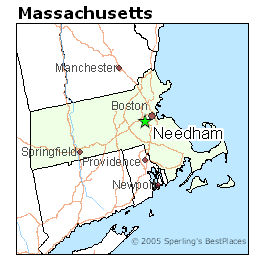
Ebenezer Newell, was born on January 4, 1712, in Needham, Massachusetts to Ebenezer and Hannah (Fisher) Newell.  He married Elizabeth Bullard on October 7, 1735, in Needham, Massachusetts.  They had three children:  Ebenezer Newell, Jr. (1736–1797), Hannah Newell (1740–1775) and Theodore Newell(1744–1817).  Elizabeth Bullard Newell died in 1752.  A year later on April 24,1753, Ebenezer married Elizabeth Allen, daughter of Hezekiah and Mary (Draper) Allen.  They had  ten children:  Elizabeth (1754-1844), Susanna (1755-), Mehitabel (1757-), Reuben  (1760-1825), Mary (1762-), Abigail (1764-1849), Olive (1766-1837), Lois (1770-), Rebecca (1773-1856), and Hannah (1776–).

Ebenezer lived in Dover, Massachusetts and was active in the community and the church.  He served as one of the town wardens and selectmen, was on the committee on inspection and safety during the Revolutionary War (See #8 What Do You Mean, I Cannot Have a Cup of Tea?  Ebenezer Newel
l) and in 1773 was the sealer of the bread in 1773, making sure that the bread met certain standards.  He was a deacon of the church and charged with taking care of the town meeting house.  For that work, he received 12 shillings a year.  While Ebenezer farmed, at times he engaged in other additional occupations.  He was a cooper and at one time, he also ran a tavern.

Ebenezer died on  January 8, 1798 at the age of 87 and is buried in Needham Cemetery.  If I were able to talk to him, I would ask him what it was like to have 13 children, if he had any advice for how to successfully raise children, if any of his children caused him problems, and if he was especially proud of any of them and their accomplishments.


Tuesday, August 11, 2015

#67--Abigail Smith--Many Questions, Few Answers

The theme for this week is to blog about one of our 32 third great grandparents.  So the first thing I had to do is figure out was who fell into that category.  That group goes back 5 generations in a family tree.

Since I like to keep my lines in separate files, it took some time to figure out who I was going to blog about.  I first settled on David Mears.  I have previously blogged about his wife, Elizabeth (#2—Elizbeth Mears) . So I thought that if I blogged about him, I would have completed that pair.  However, I quickly realized that what I would write about David Mears, I had already written about his wife Elizabeth.

So it was back to the drawing board.  After scouting around some, I decided that I would blog about Abigail Smith.  She is one of my 16 great great great grandmothers and I know little about her.
According to the Vital Records of Roxbury, Massachusetts, Abigail was born to Luke and Abigail (Bellows) Smith on June 25, 1768.  Her brother, Solomon, was born on October 25, 1766 and Thomas, on November 28, 1770.

On September 3, 1796, Abigail married Timothy Fuller, who was a physician in Dedham, the town next to Roxbury.  Three years later, on January 12, 1799 Timothy died.  Abigail then married Reuben Newell on January 3 1801.  Reuben had previously been married to Sally Battle, who died in 1795, leaving four children.  In 1803, Catherine, their only child was born to Abigail and Reuben.  According to the Columbian Centinel of February 1832, the local Dedham newspaper, Abigail
 died in Dedham, Massachusetts in that year, while her husband died in 1825.

I always find it somewhat frustrating to research female ancestors. Unless they have done something that is in some way really spectacular, there is no information about them.  That leaves lots of unanswered questions.  So if I had the opportunity, I would have a number of questions for Abigail.  I would like to know how her first husband, Timothy Fuller died and how she managed for the three years that she was his widow.  Did she return home and live with her parents?  One of her brothers?  How did her meet Reuben?  She became a step mother to four children.  What was that like?  Where did she live after her husband died.  I cannot find her in any of the census.  Way too many questions, so few answers.


Wednesday, January 7, 2015

#43 Abraham Newell—A New Start in a New World


Last year I responded to the Ancestry.com challenge to blog about one of my ancestors once a week. I did not quite make it to 52 ancestors, however, I learned a great deal about those I researched and had fun doing it.  This year, the challenge has changed to a weekly suggested theme, which I can focus on or not.  I am going to try to use the themes.

The theme for the first week is “having a fresh start.”  I think that anyone who moves to a new country or state is having a fresh start so I have a number of ancestors that got a fresh start.  My first impulse was to blog about James Hannah and how he came to Pennsylvania from Ireland.  Then I remember that I had blogged about him and what I wrote seemed pretty close to a fresh start  (See #27--JAMES HANNAH—Many Questions and few Answers) so I decided to try someone else.
Abraham Newell is my fresh start ancestor.  Abraham was born in England about 1584.  He came to Massachusetts on the ship Francis, arriving on April 24, 1634 with his wife, Frances and his children. Abraham, Sr. and his family settled in Roxbury, Massachusetts.

William Stark Newell in his books—The Ancestors of William Stark Newell—speculates as to the reasons that Abraham may have immigrated.  One speculation is that he came for religious reasons.   In England, the Puritans wanted to reform the Anglican Church and remove many of the practices left over from the Catholic Church, e.g., stained glass, statues, etc.  For those beliefs, Puritans were persecuted and as a result, came to the Colonies to worship as they wished to.  To support the idea that Abraham was a religious person and may have come for religious freedom, one need only look at the names of his children—Faith, Grace, Abraham, Jr., John, Isaac, and Jacob.  They are all biblical.  Second, Abraham joined the church in Roxbury the same year that
he arrived.  Thus, there is some reason to believe that Abraham may indeed have decided to move his family to Massachusetts for religious reasons.

Economic factors were another reason that individuals migrated.  Land in England was scare and inflation was high, making earning a decent living difficult.  If people moved to the Colonies, their chances for a better life improved. I have read that Abraham was a tailor.  At the time of his immigration, the wool trade in England was experiencing great inflation and wool was scarce.  Lack of cloth would have impacted a tailor’s ability to make a living.   Further, I do not know whether or not Abraham owned any land in England.  However, in the Colonies, land was free and with land ownership came the right to become a freeman and vote.  In Roxbury, he did own land.  The Roxbury Book of Possessions, dated about 1653 lists ten parcels of land that he owned.  If I add up the acres in them, Abraham owned 119 acres of land in various places
in Roxbury.  Using his will, from 1692, William Start Newell estimated that he had 153 acres plus some land in fresh meadows.  So it is also possible that Abraham Newell, Sr. came to the colonies for economic reasons.

It is not possible to know exactly why Abraham, Sr. came to the Colonies, however, both religious and economic reasons seems possible.  However, it looks to me that he got a fresh start—he could worship in a Puritan church and he owned land.  If I could talk to him, I surely would ask why exactly he decided to come.

Tuesday, April 1, 2014

#8 What Do You Mean, I Cannot have a Cup of Tea? Ebenezer Newell


               In  genealogy,  I am always much more interested in what people did and how they lived, rather than when they were born, died, married, etc.  Thus it is always a good when I can find out something more  about a person.  Since Patriots Day in Massachusetts is coming soon, I though in the next couple of blogs I should find out more about my relatives that were involved in the Revolutionary War. 

            One such person was my 3th great grandfather, Ebenezer Newell.  Other than the basics, I did not know much about him.  I did know that Ebenezer was born on January 4, 1712.  His parents were Josiah and Hannah (Fisher) Newell in Needham, Massachusetts.   In 1735 he married Elizabeth Bullard.  After her death in 1753 he married Elizabeth Allen.  Originally a resident of Needham, in 1748, he moved to the Strawberry Hills section of Dover.  He farmed there until 1769 when he sold the farm and moved back to Needham.   Ebenezer died on January 8, 1798.

            Since Ebenezer would have been in his sixties during the Revolutionary War, I was surprised to find that he was indeed involved in the war efforts.   According to the History of Needham, Massachusetts, 1711-1911: including West Needham, now the town of Wellesley, to its separation from Needham,   Ebenezer was on the Committee of Correspondence, Inspection and Safety during the war.  While the Committee was involved in writing to other committees about colonial issues and plans of action, and overseeing the militia, one of its most interesting tasks involved the drinking of tea.  In essence, because the taxes on tea supported the British, the Committee was to see that the people in the town did not drink tea.

            According to Frank Smith (1897) in Narrative History:  A History of Dover, Massachusetts as a Precinct, Parish, District and Town: 
            On December 5, 1774, the town voted “that we do not further engage that we will not drink, nor suffer any in our families to drink, any kind of India tea till we have a full redress of all the grievances enumerated in the Association Agreement”  …The committee of inspection were instructed to endeavor to find out whether any of the inhabitants presumed to violate the foregoing engagement, and if any were found acting contrary thereto, to post up their names in some public place in each parish as enemies of the welfare of America.

            I can find no records of people whose names were posted or how Ebenezer and the other committee members went about this task.  Thus, if I could talk to Ebenezer, I would ask:  How did you find out who was drinking tea?  Did you post their names?  How did other people react to those who had their names posted:  What did people drink in place of tea?