Welcome to my genealogy blog. Ancestors I Wish I Knew is a combination of genealogical information and stories about individuals in my family tree. The focus is on those from my Cochrane, Eitelbach, Merrett, Minarcik and Richards lines and their descendants.

Showing posts with label Minarcik. Show all posts

Monday, May 6, 2019

#179--Baking with Nana


The genealogy theme for this week is nurture.  When I looked up the definition of nurture, I found things like to take care of, feed, or protect.  The word feed struck me and reminded me of my material grandmother (Nana), Regina Minarcik Eitelbach.  She was an amazing cook and often had her family for Sunday dinner.  That dinner might consist of a roasted chicken or pork loin, two vegetables, potatoes, and a cake and pie for dessert.

Nana was best known for her baking.  She could bake anything—all kinds of cakes and pies.  I remember her lemon meringue pie had a wonderful flaky crust, a nice lemony filling and a lot of meringue.  When I was little, sometimes I went to visit Nana.  We would go to the park, grocery shop, and visit a five and dime type place, called Lewis of Woodhaven. Sometimes she came to visit us.  Often, she and I would bake.  Usually we baked cupcakes.  My favorite part was to frost them in a rainbow of colors—pink, blue, green, yellow.

Unfortunately, Nana died before she could really teach me how to bake.  However, my mother had a notebook of Nana’s recipes, which I now have.  Some of the recipes are easy to follow and others are not.  I have no idea how much butter is the size of an egg or how much more flour to add to a cup so that it “feels right.”  Here is the recipe for those cupcakes which is pretty clear.

Nana’s Cupcakes
¼ pound of butter
1 cup of sugar
3 eggs
2 full cups of Presto flour
¼ cup milk
tsp of vanilla
Cream the butter and sugar
Add the eggs, milk, and vanilla
 and then slowly add the flour
Frost with confection sugar  and butter

There is no oven temperature listed, but I think 350 degrees for about 20 minutes would be good.

I really wish I could talk to Nana about baking.  How she learned, what her favorite recipes were, did she ever bake something that failed?

Sunday, July 22, 2018

# 137 New York, New York


Music, the theme for this week, had me stumped for a long time, until I read Amy Johnson Crow’s suggestion that a song might be appropriate.  That made me think of the lyrics from On the Town,   which begins as follows:

New York, New York
New York, New York
New York, New York
It's a wonderful town!

Evidently many of my ancestors thought that New York was a wonderful town because that is where they settled.

Willett Street
The first to come to New York were my great great grandparents, Joseph Munarzik, his wife Regina Wendel, and his children.  They arrived in New York in 1854.  As far as I can tell, they lived on the lower east side of Manhattan in the 17th District.  Interestingly, Regina Wendel’s parents came on the same ship and also lived on the lower east side.  After Joseph and his wife died, their children lived in the same house as the Wendels, 67 Willett Street, Manhattan,  New York.

Next to arrive from Europe were my great grandparents, Louis and Marie (Huelster) Eitelbach with four of their children.  They came in 1896 and originally lived at 1287 Greene Street, Brooklyn, New York, USA.  By 1912 they had moved to Queens, New York at 141 Napier.  Later on, the family lived in Hempstead and Richmond Hill, both in Queens

I have other ancestors, who originally lived somewhere else, and moved to Brooklyn.  William Cochrane, my great great grandfather, and his wife, Emma Merrett originally came from London, England in about 1835, settled in Buffalo, New York, and then in about 1840 moved to Brooklyn with their five children. They always lived at 124 Fort Greene Place.

Park Slope Brooklyn
The last to arrive in New York was my great great grandfather, Abiathar Richards.  He was born in Dedham, Massachusetts in 1837, lived while a boy with his Aunt Lavinia Richards and her husband, Seth Richards, in Newport, New Hampshire, and by 1860 he had moved to Brookklyn, New York to live with this brother, Abner Richards. In 1866 he married Mary Jane Cochrane, daughter of William Cochrane.  They moved into 124 Fort Greene Place and lived there until Abiathar’s death in 1905.  At that time his wife, Mary Jane, moved in with her daughter Gertrude, and her son-in-law, William D. Hannah.  Gertrude and William D. Hannah met in Auburn, New York while she was visiting her cousin, Lucy Pingree, fell in love, married in 1902 and shortly thereafter moved to Park Slope, Brooklyn.

I would like to be able to ask each of these families why they settled where they did and what their lives were like there.  

Thursday, July 12, 2018

#136--Traveling with Cousin Jean


This week’s theme is travel.  I have blogged about Chet Richards’s trips and the postcards , he sent to his family in the early 1900’s.  So when I saw the theme, I immediately thought of my postcards.  When I looked through them, I realized I had a number of them that my mother’s cousin, Jean Roberts had sent to her.

Cousin Jean was born 21 Sep 1906 Kings, New York, USA  Her parents were William Alexander and Christina (Minarcik) Roberts.  For her entire life, she was a Broklynite, until her death in May of 1977.

.

Cousin Jean loved to travel through New England.  In the Spring, she liked to see the flowers and in the Fall, the leaves turning different colors.  A dedicated “birder,” any time she traveled she looked for birds.  Cousin Jean had a novel way of deciding when to take her trips through New York so she would not miss what she wanted to see.  She worked in Brooklyn in one of the probation offices.  In that office, newly released prisoners needed to check in.  She always asked those coming from upstate New York about the condition of the trees and flowers!

Here are a couple of the postcards, she sent to my mother.

This is one from Bangall, New York:  She wrote:  

"Hi—I lived up to my reputation as being a drought-breaker—much rain and snow flurries predicted for today.  Have been getting good food and rest.  On Wednesday drove through an apple orchard on the way to Germantown.  I doubt I will continue to New Hampshire as I think there will be little in bloom up there with this weather."


Jean also liked to go to New Hampshire;  here is a card from Clarksville, where it seems all did not go well in the car department:

"This is one of my favorite views at or back at the White Mountains…Leaves just appearing and was like winter when I arrived.  Right now the proprietor is changing a flat tire for me."


And another from Connecticut Lake, New Hampshire:

"Finally reached my favorite birding spot near the Canadian Border.  Very crowded with fisherman for Memorial Weekend.  I was fortunate to get a cottage.  Was very cold until Saturday and much snow still in the woods and on shady roads.  I will probably take a slow route home via Maine.  From my cottage I can see Maine Mountains."


I wish I had asked Cousin Jean more about her trips.  It would be fun to know what was the most exciting things that happened, what places she did not like, if she was anxious about traveling along and if she had any experiences that could be considered dangerous.  

Sunday, May 13, 2018

#127 Mother's Day


It should be no surprise that the theme for this week is Mother's Day.  I have two other blogs on this theme: Happy Mother's Day and Happy Mother's Day Maria Huelster so it was time to figure out what to do now.  I have lots and lots of mothers in my tree, but somehow blogging about them was not what I wanted to do.  When I think about mothers, I think about my mother and my grandmothers so I wanted to focus on them.  Also wanted to be able to use  pictures and was delighted that I could find some taken when I was a baby.

Here is one of me and my mother in Prospect Park.


 Next is my Nana, Regina Minarcik Eitelbach, holding me.


 Here is my Granny, Gertrude Richards Hannah, also holding me.


My great grandmother Oma, Maria Huelster Eitelbach also would come to visit,and here she is with me on her lap.


And last here is one of my Oma, Nana, my Mother and me.  I just love their hats.


What an amazing group of women.  I was so fortunately to have them in my life and miss them every day.

Saturday, February 11, 2017

#99 Organizing the Minarciks, Eitelbachs, Hannah, and Richards—A Follow-Up


It has been an incredibly busy January and somehow this blog was put on the back burner. I did, however, think about my genealogy goals for last year. One of those goals was to organize all the documents that I have for my various lines. As I previously blogged, I decided that the best way for me to do that was to use the loose leaf notebook method. Each line has its own color-coded notebook, which is divided into sections for each person. The first document in each notebook is a chart that contains the ancestors who are in the notebook. After some experimentation, I decided to start with the most recent ancestor and work my way back.

So how did I do?  Pretty well.  My four main direct lines—Minarcik, Eitelbach, Hannah, and Richards were completed.  I now have birth, marriage and death information for each person along with other information that is unique to that person, e.g. pension records, land records, etc. A great deal of what I had was online so I did a lot of printing.  I also had to do some searching as I discovered that I was missing some of the information I wanted for some people.  Each document is in its own clear plastic holder.

Having gotten those lines done, I then turned to the collateral lines:  I completed the Cochrane line and most of the Mears.  I am now working the Newells.

This procedure was not with some problems.  One of the problems that I ran into while looking for a particular record was getting distracted and going off in another direction.  I found some interesting information while doing that, but it certainly did slow the process down.  Another problem was ending up reading all the information I had.  That was a plus and a minus.  I learned more, but got slowed down.

So what is up for this year?  I want to get the rest of the lines organized.  I also have a very, very large number of pictures.  I want to go through them and decide which ones to keep, which ones to scan, and which to discard. Tune in next year and see how I did.

Thursday, November 10, 2016

#94--From There to Here--The Richards, Hannahs, Minarciks and Eitelbachs Arrive


I recently flew to and from Europe.  It took about 8 hours to get to Spain and about 10 hours to fly back from Rome.  During those flights, I thought about my ancestors who came to America and what they may have experienced.  They arrived along before airplanes crossed the ocean so I decided to go back and look at the ships that they took to get here.  I also decided to focus on my four main lines—Richards, Hannah, Eitelbach and Minarcik.

Edward Richards is my earliest immigrant ancestor.  According to Cutter in “New England Families, Genealogical and Memorial, V. 2., Edward Richards came from England about 1632.  While not listed on the ship manifest, he is presumed to have come on the Lyon with his brother Nathaniel.  The Lyon sailed from London on June 22 and arrived in Boston on September 16.  While they were on the ship for 12 weeks, for only 8 of those weeks were they at sea.

James Hannah is my next immigrant ancestor to arrive.  However, I have not been able to figure out exactly where or when he landed.  I do, however, have some idea of when he might have immigrated. The earliest document that I am able to locate is an 1806 application for a land warrant in Armstrong Count, in which James swears that he and his family settled on the land in 1799, built two cabins, cleared the land and planted crops.  Andrew Mckee, his father-in-law, and Phillip Anthony both swore that James Hannah had lived there for at least five years.  Further, his oldest child, James Hannah, consistently states that he was born in 1795.  So my best guess is that James landed in the Philadelphia area some time before 1795, married Nancy McKee and along with his father-in-law and his family moved to Armstrong County.  At that time, it took 7 to 8 weeks to cross the Atlantic.

.Le Havre in the 1850's
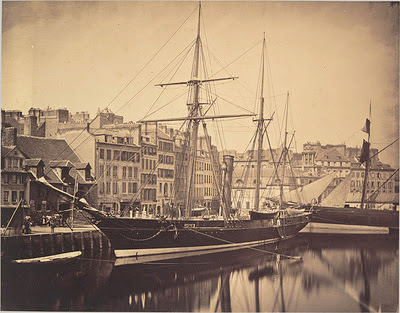
My third group of ancestor were the Minarciks.  On June 27, 1854  Joseph Munarzick with his wife, Regina and two children—Elizabeth and Carl—arrived in the port of New York.  They sailed from LeHavre, France on the ship William Tell, a 3-masted, square-rigged sailing ship on May 21.  The
William Tell arrived in New York on June 27.  The voyage lasted 38 days. According to the ship manifest, there were 618 passangers on board along with cargo.  Interestingly, Regina Munarizick’s parents, John and Catherine Wende along with their children—Marie, Catherine, Carol, Susan and John—were on the same ship.

Rhyland
The last to arrive there the Eitelbachs.  They sailed on the Red Star Line’s Rhynland, a four-masted steam ship.  While I cannot pin down exactly when they left Antwerp, they arrived in New York on May 23, 1895.  The Red Star Lines’ web page indicates that the voyage typically  took from 7 to 10 days, so they should have left sometime between  May 13 to 16.  Looking at the passenger list, I learned that they came third class or steerage, their quarters were in the stern of the ship and they brought 5 pieces of luggage with them.  I also saw that Louis described himself as a locksmith.

So over the course of about 400 years, the amount of time it took to travel from Europe to the United States dropped from 8 weeks for Edward Richards to 38 days for the Minarciks, to 7 to 10 days for the Eitelbachs to my 10 hours.  I know what my trip was like, I would like to know more about theirs.

Monday, September 19, 2016

#92--Richards, Hannah, Cochrane, Eitelbach and Minarcik--Where Are You Really From?


A while ago, I decided that I would have Ancestry.com analyze my DNA.  I ordered the kit, spit my saliva into the tube and anxiously awaiting for the results.  Like a watched pot that did not boil, it seemed to take forever.  Then, one day I got an e-mail that something had happened and they were not able to do the analysis.  I was so disappointed.  Fortunately, they sent me another kit—this one was free and I began to wait again. 

I knew there were two parts of the analysis:  one that focuses on your ethnic background and the other that connects your DNA to people who have also submitted their DNA to ancestry. Because I have been working on various lines in my family for over ten years and can go many centuries back, I was pretty sure that I knew my ethnic background. Had you asked me, I would have told you I was English, Irish, and German with maybe a little Czechoslovakian.  I was much more interested in learning who I was related to, and hoped that some of those connections would break down a couple of my brick walls. 

So one day, while I was not thinking about it, an e-mail arrived announcing that my DNA results were available.  I was delighted.  When I looked at the ethnic results, I felt a little bit like the man in
the Ancestry commercial who thought he was German and always wore his Lederhosen, but found he was Scotch Irish and now wears a kilt.  Some of my results were not at all what I expected and others made sense.  My DNA tested as:  Scandinavia-- 33%; Ireland--32%; Western Europe--16%; Iberian Peninsula--12%; Great Britain--4% and Italy/Greece--3%.

I could easily connect some of my lines to these locations.  My Hannah line has strong roots in Ireland so that made sense.  The Eitelbacks and Minarciks came from Germany and some of long ago relatives lived in Normady, France.  That accounted for Western Europe.  Scandinavian?  Actually, when I thought about it and read some of the information that Ancestry supplies, it made great sense.  In the Middle Ages the Danes invaded the eastern portion of British Isles and after the invasion, they stayed.  My Richards line and most of its collateral lines comes from that part of England.   The Iberian Pennisula connection baffled me.  However, I learned that in about 5,000 B.C there was a migration of individuals from what is now northern Spain to Ireland and that there was a second migration in the 4,000 B.C. era from Germany.    The named location does not always correspond to what I thought it should be and that is true for the Italy/Greece connection.  When I looked on the map and read the accompanying information, the location also included parts of Spain and France. 


If you are wondering about how successful I was in connecting to other people, stay tuned.  In the meantime, like the man in the Ancestry commercial I am considering whether I should give up my Christmas Wassail Bowl and begin serving Danish Glogg.

Wednesday, August 31, 2016

#92 --The Wendels and the Minarciks ---Living on the Lower East Side in KleinDeutschland


Willett Street 


On June 27, 1854 my great grandparents, Joseph and Regina (Wendel) Minarzick (now spelled Minarcik) , and their two children, and my great, great grandparents, John and Katherine (Kolh) Wendel and four of their children arrive in New York City on the ship William Tell.  As did most German immigrants, they lived in the tenements on the lower East Side, which was also known as Kleindeutschland (Little Germany).   Germans coming to New York clustered together in a 400 block area of Manhattan from Division Street up to 14th street and from the Bowery to Avenue D.  From what I have read, they brought much of their German culture with them.  There were beergartens and saloons, German language newspapers, social clubs, shooting clubs, singing societies, banks, libraries, theaters, etc.  So when I was in New York with the New English Historical and Genealogical Society, I was excited to be able to visit the Tenement Museum at 97 Orchard Street and learn what life might have been like for them.

The Tenement Museum has several tours.  We took the one that focused on the German saloon run by John and Caroline Schneider.  The saloon was in the front of the house on the first floor and the Schneiders lived behind it.  I thought it was particularly interesting that in 1880 there were 346
Tenement Museum
saloons in Kleindeutschland and wondered which ones my ancestors went to.   I was surprised at the number of places to drink, but learned it was not that the Germans drank that much, but rather that the apartments in the tenements were so small that having company over was very difficult.  So people met their friends in the bars and saloons.

In the early 1850’s, well-to-do individuals who owned homes in the area were moving north.  Their homes were then subdivided into apartments.  In some cases additional floors were added to the original house so that these houses, known as tenements, would be four or five stores high.  The typical tenement house was 100 feet long and 25 feet wide.  Tenements originally had no gas for heating or any lighting; the only light came from the windows in the front and back of the building.  However, in 1901 city regulations required electric lighting in the hallways.  The bathroom and water were located out back behind the tenement.  Typically, each floor contained 4 apartments with each apartment consisting of a kitchen, parlor, and bedroom.  However, there were larger apartments available
Floor Plan of Tenement
to those with more income.

Given that information, I wondered where they lived in New York.  The 1860 census provided some basic information:  both families lived in the 17th Ward, 5th Division.  In fact, they are listed on the same census page.  The Wendels were in Dwelling Number 22 along with four other families.  The Minarciks were in Dwelling Number 23, with four other families.  Given the Dwelling Numbers, I assume that the houses were next door to each other; if not they were certainly close.  In 1870 they were still in the 17th Ward, but in the 22 District.  The Minarciks were in Dwelling Number 177 with 6 families.  The Wendels—Just John and his daughter, Elizabeth-- in in Dwelling Number 194 with 12 families.  One family moved, but I do not know which one.  Prior to the 1880 census, Joseph Minarcik and his wife died.  That left Charles, their oldest son as the head of the family, living with his four brothers and sisters and in the same house as the Wendels—both at 67 Willett Street, New York.  When I tried to find Willett Street on a map of New York City, I discovered that the street no longer existed, but had been replaced by the Samuel Gompers Housing project.  That project is north
1869 Map with Willett on the far left
of Delancy Street on Pitt Street.  So at least I know the general area.  With a little more digging on line, I found an 1869 map of the area with Willett Street and all the houses on Willett on it.

So I knew where they were in 1880, but where were they in 1860 and 1870?  I knew that they were in the 17th Ward.  Fortunately, I found both families in several city directories.  In 1857, the Minarciks were at 174 3rd Avenue, which is between 16 and 17th Streets and in 1872, 177 2nd Avenue, between 11 and 12 street.  I could not find them in any of the years between.  From 1868 until 1877, the Wendels were at 194 Third Avenue between 17th and 18th Street.  So they lived rather close to each other.  When I looked at those addresses on line, the buildings had all been replaced with more modern ones.

I would like to ask the Wendels and the Minarciks about their life in the Lower East Side Kleindeutschland.  How did they pick their apartments?  What were their neighbors like?  Why did they move?  How much was the rent?  How did they manage in the cold of winter and the heat of summer?  What did they do for entertainment?

Thursday, June 9, 2016

#86--Genealogy on the Road--Part 2

Last week I blogged about the research part of my genealogy tour with the New England Historic and Genealogy Society.  However, it was not all research; we also went to several places that fit nicely into genealogy.  So this week, I will blog about those.

Late Wednesday afternoon, we went to the Tenement Museum at 97 Orchard Street on the Lower East Side of Manhattan.  The Museum has several different tour, focusing on various aspects of the immigrant experience in New York.  We did the Shop Life tour, and learned about the saloon run in
Lower East Side
the 1870’s by John and Caroline Schneider.  I was surprised to learn that at that time there were about 129 saloons in the neighborhood.  It was not that the German immigrants drank too much, the saloons served as gathering places for the residents.  The apartments were so small and cramped that one could not invited people over, rather they met in the local saloon.  I was particularly interested in seeing the tenement Museum because my immigrant ancestors the Wendels and the Minarciks settled on the lower East Side when they came over from Germany.  I also realized that the Wendels lived on the block, Allen Street, behind Orchard Street

The next day we got up early and took our bus to Brooklyn to visit Green-Wood Cemetery.  That is a place I am very familiar with.
Main Gate of Green-Wood Cemetery
Minerva Saluting the
Statue of Liberty
 My parents, grandparents, great grandparents and assorted cousins are all buried there.  It is also where I am planning on spending eternity.  Green-Wood goes back to the mid-1800’s and the rural cemetery movement.  It is 478 acres of rolling hills, winding roads, grass and trees.  We stopped at several places:  the memorial to the Civil War Soldiers, the Statue of Minerva, who is saluting the Statue of Liberty, and several interesting tombs and mausoleums.  I was particularly surprised that one mausoleum has both light and heat!

Saturday was devoted to going to the Statue of Liberty and to Ellis Island.  I am embarrassed to admit that as a native New Yorker I had never visited Lady Liberty.   The views of
Statue of Liberty
the Statue from the boat were wonderful.  She just got bigger and bigger.   After going though security for the second time after arriving that the statue, we took the elevator to the top viewing platform.  We could see lower Manhattan with the new World Trade Center, Brooklyn and its bridge, Staten Island, and New
Lady Liberty from below
Jersey.  We walked down to the other viewing platforms and eventually reached the bottom.  I was fascinated by the different views of the Statue when seen from below rather than straight on.

Then, it was on to Ellis Island.  Now I had been to Ellis Island, right after it opened; since then it has expanded a great deal.  There are several options:  We did the audio tour of the immigrant experience.
Ellis Island
 In other words, we followed the path an arriving immigrant would take as she or he tried to enter the United States.  My great grandmother and father, Maria and Louis Eitelbach, came through Ellis Island in 1896 along with their 3 oldest sons.  One of those sons was my grandfather.  I thought a lot about how that experience must have been for them.

If I could talk to my ancestors, I would have several questions.  I would like to ask the Wendels and Minarciks what their life was like on the Lower East Side.  How many people lived in their tenement?  Did they often go to a saloon?  For my great grandmother, Maria Eitelbach, I would ask how long their voyage lasted?   How did she manage her three small children on the ship?  How long did it take for them to get through Ellis Island?  Were there any delays?  If so, what?

Tuesday, May 31, 2016

#85 Genealogy on the Road

I spent last week in New York City on a genealogy research tour with the New England Historic and Genealogical Society (NEHGS).  Since I grew up in Brooklyn, this was a tour that was just perfect for me.  I liked that the tour combined genealogical research with visiting places that involved immigrants coming to New York City.  I have relatives who lived in New York City since the mid 1850’s so this was an opportunity for me to find out more about them, particularly about how they lived and what they did.  This is the first of several blog posts that will focus on my research tour.  This one will just highlight where we went and what I found without going into any findings in depth.

We spent the major of our research time at the New York Public Library (NYPL).  While you may be familiar with the outside of the building with its magnificent lions, Patience and Endurance, what you may not know is that the inside is absolutely gorgeous. The marble interior is filled with artwork, sculpture, and polished wood.  It was amazing to be able to work there.  I requested a number of
Lion outside New York Public Library
books on Brown County, Ohio and used newspaper data bases that I were never available to me before.  My main focus for the NYPL was to expand my information about the Hannah’s in Brown County Ohio and to dig into the newspapers in Dedham Massachusetts and in the Caribbean. I was delighted to find that my great, great, great grandfather, James Hannah’s, will had been filed in Brown County, not Hamilton County where he died and where I had been looking for it and  find out more about the businesses that, Reuben Newell, my great, great grandfather, ran in Dedham.

We spent an all-to-brief afternoon at the Brooklyn Historic Society.  In their catalog I found the the archives for Packer Collegiate Institute, a school that my grandmother, mother, aunt and cousin had attended.  I also went there.  While I knew that my grandmother was a “Packer-Girl”, I was never exactly sure when she attended so I requested all the catalogs from 1865 to 1900.
Packer Collegiate Institute about 1890
At the library, I started to go through them year by year and it was not long before I found Gertrude Richards in the catalogs from the late 1880’s and early 1890’s along with curriculum.  I had a little more time at the Historical Society, which I used to find out whether or not any of my grandmother’s Cochrane aunts had also gone to Packer. And indeed one had; there in the in the 1865 and 1866 catalogs was Evalina Cochrane along with the curriculum for young women during the Civil War.  It is going to take me a while to figure out what kind of education each of them received.  The school was not divided into high and elementary school, but into various departments with several grades in each.

We also spent an afternoon at the New York City Municipal archives.  Several years ago, I had ordered death certificates for a number of my ancestors, so this was my opportunity to look at several more.  I knew exactly what I wanted there—death certificates for my Minarcik grandparents.  Despite
Ceiling Mosaic NY Municipal Archives
the fact that I have a love-hate relationship with microfilm machines, I did find both their certificates. By the way, the ceilings on the first floor of the archive building are covered with beautiful mosaics.

I am so pleased with all the information I found, and I will blog more about it later.  However, it is important to point out that I would not have been so successful had it not been for the very helpful librarians at each location and the genealogists from the NEHGS.


Thursday, January 7, 2016

#78--Organizing the Minarciks, Eitelbachs, Cochranes, and Richards


Over the years I have collected an awful lot of papers pertaining to various ancestors.  Some of them are organized into folders, others are in notebooks and still others are loose.  So my resolution for this year in terms of genealogy was to get those papers organized.

 I looked at a variety of different methods for organizing them:    How to Organize Your Files;   Organizing your Records. You can use file folders, notebooks, and numbering systems.  I decided that the notebook scheme would work best for me.  I used loose leaf notebooks to organize my courses when I taught, so this seemed comfortable for me.

Not wanting to get totally overwhelmed, I decided to begin with the lines of my grandparents—Richards, Hannah, Eitelbach and Minarcik.  So the first step was to buy four notebooks, each a different color.  That way each line is a different color and I can tell at a glance what the line is.  I also bought clear plastic page protectors, and section dividers.  Now I had no excuse.  I decided to start with the shortest line, the Minarciks,  as it would be the easiest and would give me some sense of accomplishment as well as find out if this was really going to work for me.

I began by sorting the pages into categories by person—Regina, Charles Jr., Charles Sr. and Joseph.  For each person then put the pages in order—I wanted each person’s section to begin with the basic information--a family group sheet and if it was available:  birth, marriage and death records.
 Then, I wanted to put in the census information, followed by whatever other information I had.  For example, Charles, Sr. Pension File from the Indian War would go after the census.

At the beginning of each notebook, I put a pedigree chart.  Then, for each person, beginning with the most recent one, I put each page into its page protector and then into the notebook—maroon for the Minarciks.  Each person separated by a page divider.

There is one thing missing—a list of what I have for each person.  I looked at some checklists on line, but I want to come up with my own checklist for each person that will tell me exactly what I have in terms of documentation as well as what I do not have.  There is one other loose end.  I have not decided what to do with the pictures I have of people.  They are generally of odd sizes so typical picture pages will not work and I think they could end up in a heap in the bottom of a page protector.
So what is my reaction to this method of organizing?  So far, I am pleased with it.  All the information for the Minarcik line is in one place.  I can easily find what I am looking for.  It would be easy to add additional documents.  On the negative side, it took me a good deal of time to organize a rather short line.

Tuesday, June 2, 2015

#60--Regina Wendel--New Beginning for Her and for Me.


This week’s theme is commencement or new beginnings.   This blog is a new beginning for me and for the Wendells.  I thought I would have a “new beginning” by research a line that I had pretty much overlooked before.  I picked my Wendel line, and specifically Regina Wendel, my great, great, great grandmother and her family.  They migrated to the United States so that is a new beginning for them, too.  I have done some research on Regina's husband, Joseph Minarzik (Blog #6--Joseph Minarzik—How Do You Spell That Name), but not Regina.

Battenberg Castle
Searches in Ancestry.com and Family Search.org provided me the information I was looking for.   I found Regina Wendel was born in Battenberg, Germany in 1825.  She was one of twelve children born to Johannes Wendel and Katherine Kohl.  On September 9, 1849 she married Joseph Minarzick.  I am still not sure about the date she and Joseph came to the United States.  However, Charles, their oldest son, in his application for an army pension swore that he was born in New York City in 1853.  So, they immigrated sometime between 1849 and 1853.

In the 1860 census, Joseph and Regina have 8 children:
.Tenement
Charles, Elizabeth, Cary, Susan, John, Maria, Louisa, and Kate.  They were living in the lower east side of Manhattan in the 17th District, Ward 22.  Joseph was working as a tailor.  Regina Wendel Minarcik died on June 18, 1878, three years after her husband died.

While I am saving them for another day, I also found two of her brothers, Konard and John, in New York City in the 1870 census.

If I could talk to Regina, I would like to know why she and Joseph decided to come to the United States and to live in New York.  I would also like to know about her experiences of living in a tenement in New York as well as about raising 8 children.


Monday, March 16, 2015

#50 An Amazing Experience


I got back last week from an amazing experience.  I spent a week in Washinggon, D. C. on a week-long genealogy research tour with the New England Historic and Genealogical Society.  Imagine spending all that time with people who share your passion, understand your roadblocks, and can talk about things that most of your friends would consider very strange.  The first two days were devoted to getting to know and doing some preliminary research in the three sites:  Library of Congress, National Archives, and the Daughters of the Revolution Library.  Each one has its own rules and regulations, from what you can take in, copying fees, security screenings, cards, etc. For example,  you can take a purse into the DAR library with no size restrictions, your purse at the Library of Congress must be less than 9 by 6 inches, and you can take no purse into the archives, just a small clear plastic bag.    All that combined with finding out how to locate what you wanted was a little daunting, even though I had spent time looking at their websites and getting familiar with each one.    However, the NEHGS staff and the librarians at the sites were extremely helpful and I pretty soon had figured out how things worked.

So what did I find?  I went with some very clear questions that I wanted to try to answers and was able to answer some of them.  I confirmed that James Hannah did indeed fight in the War of 1812.  I found his muster cards on Fold3 at the National Archives.  He was a private in  the Pennsylvania Regiment commanded by Rees Hill.  I was not able to find where he lived in Cincinnati, Ohio or where he was buried.  From his pension file, I discovered that Joseph Minarcik, my great, great grandfather not only was with the 2nd Cavalry when it explored Yellowstone National Park, he was in battles against Sitting Bull and Crazy Horse!  For John Wesley Hannah, my great grandfather, I was looking for additional information about his Civil War service.  I found a number of documents that he signed.  Some were affidavits attesting that a particular soldier had indeed fought while others were rather sad, as they were the documents he signed when a soldier died.  Most exciting, however,
was to hold in my hands the letter that he wrote at the end of his tour of duty, requesting to be discharged and return home –that was much more personal and real to me.   There were questions that I was not able to answer.  Brick walls I did not knock down.  That is OK because for now I know
there is no answer, but maybe there will be in the future.

One of the best parts of the tour was the chance to interact with the NEHGS genealogists.  I learned a great deal from them.  From Rhonda McClure, I learned that you need to go beyond and look at the details in a documents and see where it leads you.  I have already used that and found that when you get a document in Ancestry.com, you need to look at the following pages as there may be more information.  Henry Huff gave me some great clues of how to get through a brick wall by looking at how others have solved similar problems, and David Dearborn taught me that there is much more information about the soldiers in the Civil War than the muster rolls and regimental histories.

My task now is to digest and organize all the information I gathered.  Stay tuned—I also gathered some information about my great grandmother’s three brothers and their service in the Civil War.

Wednesday, February 11, 2015

#48--Joseph Minarcik--You Came a Long Way

.
The theme for this week is  far away in either time or distance.  I have written two recent blogs about ancestors in the Middle Ages so I decided on distance rather than time.  First I had to figure out which ancestors came from  the farthest away.   I have three lines from Germany so I knew it would be one of them.  The Eitelbachs were from Hagen, which is 4,042 miles away, the Huelsters from Schollenberg, which is 4,080 miles and the Minarciks were from Winnweiler, which is 4,120 miles.  So if this is a contest, the Minarciks would win. 

Map Showing Winnweiler
Joseph and Regina (Wendel) Munarzik were my emigrant ancestors. Joseph and Regina were married on September 8, 1849  in  Battenberg, , Bavaria Germany.  I do not exactly when they came, but believe that they came to New York City sometime between 1850 and 1860.  I tried unsuccessfully to find them in the Castle Gardens database, but could not do so.  I am pretty sure they are there, but I have found that their last name has been spelled in a number of way (see Blog #6—Joseph Munarzik—How Do You Spell that Name?).    I know they were there in 1860 as they appear in the United States Census in New York City, with their 5 children.   

I had never heard of Winnweiler .  A couple of internet searches and I learned that it is in the Bavarian section of Germany, specifically in Donnersbergkreis municipality, south and west of Frankfort.  The population in 2008 was about 4600.  This is a very mountainous region, but also a very rural one.

I found a couple of pictures and was impressed with the beauty of the area.


If I could talk to Joseph and Regina Wendell, I would want to know why they came to the United States, what ship they came on, what the voyage was like, whether or not they came with other people they knew, and when they came.