Welcome to my genealogy blog. Ancestors I Wish I Knew is a combination of genealogical information and stories about individuals in my family tree. The focus is on those from my Cochrane, Eitelbach, Merrett, Minarcik and Richards lines and their descendants.

Showing posts with label Hannah. Show all posts

Thursday, December 5, 2019

#108 Needlepointing


I do not think of my ancestors as being particularly talented in terms of crafts.  However, when I look around my house, I see several things that my mother made. 

My mother was an avid needlepointer.  I can see her sitting on the sofa, with her needle point in her lap.   I have two footstools that she made.  

Here is the red one 


and here is the gold one. 


She also taught me to needlepoint.  Several years ago, I found a needlepoint canvas that I did years ago, and turned it into a pillow.


She also made a number of kneelers for the altar at our church.

I would like to ask my mother more about her needlepointing>  When she started?  Who taught her? Which piece did she like the most?

Tuesday, November 26, 2019

#106 Soldier


I think of the he War of 1812 (1812-1815) as a kind of forgotten war.  It is sandwiched between the Revolution War and the Civil War and does not get a lot of attention.  However, it was an important war.  It was fought because of British restrictions on U.S. trade, America’s desire to expand its territory, and the impressment of United States sailors into the Royal Navy. 

The war did not go well for the United States with several defeats.  Most notable was the burning of the White House in 1814.   However, the The United States was victorious in New York, Baltimore and New Orleans.  

My great great great grandfather, James Hannah fought in the War of 1812.  He enlisted in the 147 Regiment of the Pennsylvania Militia under Colonel Rees Hill.  They were stationed in Erie, Pennsylvania to guard the navel facility.  There is no other information about what he did in the war or how long he served.  

If I could talk to him, I would like to know exactly what he did, how long he served, and if he was in any battles.


Monday, October 7, 2019

#199 Harvest time with Sarah Ann Hannah


The theme for this week is harvest.  I have many relatives who were farmers; the vast majority of them were men; however, a several were women.  Previously, I blogged about Jane Mears Calvin, my 3 great aunt who also ran a farm.  So my blog this week focuses on Sarah Ann Hannah Mitchell , who ran the family farm after her husband, Joseph, died. Sarah is my great great aunt. 

Sarah Ann Hannah was born on February 17, 1823, in Brown or Clermont County, Ohio,.  Her parents were John M. and Charity (Mears) Hannah. She married Joseph Mitchell and they had five children together. Joseph died in 1857.  Many years later she  married Samuel McCampbell on October 24, 1892,. She died on February 24, 1906, at the age of 83.

The Illinois Public Domain Land Tract Sales indicate that Joseph Mitchell did not buy any land of the from the federal government.  However, he did buy land from some of his relatives, e.g. John M. Hannah, John Wesley Hannah, etc.  The land was mostly in Ross Township in Edgar County and where he and his family lived and farmed. 

The 1860 Agricultural Census Schedule lists Sarah Mitchell as the owner of a farm.  The farm consisted of 80 improved acres and 32 unimproved with a value of $2000.  $100 was the value of the machinery and farm implements. Sarah had 5 horses, 3 milch cows, 1 other cattle, 20 sheep and 12 swine.  The livestock was valued at $570.  The farm produced 1500 bushels of Indian corn and 86 pounds of wool. The farm produced 100 pounds of butter.  The animals that were slaughtered during the year were worth $30. When I looked at the other farms which were listed, Jane’s farm was pretty typical, not the largest, not the smallest, just kind of in the middle. 

I would love to talk to Sarah  and find out how she ran the farm.  Did her children do most of the work?  Did she hire people to help her? How did she learn to manage the farm?  Did she make changes to the farm as time when on?  Her sister-in-law Sarah Ann Hannah Mitchell also ran the family farm after her husband died in 1857 (See blog on the right side of this page).  I am wondering since Jane had been running her farm for some time, she provided any advice to Sarah.


Tuesday, October 1, 2019

#198--Touring Auburn, New York


My great aunt, Anne Hannah, married Charles Ross and moved from Butler, Missouri to Auburn, New York.  When her father, John Wesley Hannah (1839-1899) died, her brother William and her four sisters, also moved to Auburn.  William married Gertrude Cochrane, who came to Auburn to visit her cousin, Lucy Pingree.   My father and his sister were both born in Auburn.  They lived at 187 Genessee Street with William sister, Anne Hannah and her husband, Charles Ross.

Auburn is in upstate New York, in the Finger Lake Region, more specifically on north end of Owasco Lake.  I have never been to Auburn, but it occurred to me that I could use Google Earth, 
Goggle Maps, and Google Images to learn about Auburn and see what it looked like. 

I started by going to Google Maps.  I put Auburn, New York in the search box and when the map came up, I started at Genesee Street and South Street, and drove down South Street.  I was impressed that South street was a mix of older buildings and new ones.


                                                                              Right out of town was the Auburn
Auburn Correctional System
Correctional System, a very large prison, which was established in 1816. The Hannahs lived on South Street, at 136, very near the prison.  The fact that it was near the prison and prisoners did escape made my grandmother very nervous as her husband often traveled so they moved to back to Genesee Street.


I tried to find a picture of that house, but as luck would have it, the house was behind one very big tree, but I did find a postcard of the street in the
Genesee
early 1900’s.  As I continued down Genessee Street, I came upon The Cayuga Museum of History and Art and Case Research Lab Historic Site.


Head Stone of Anne Hannah Ross


Close by I found Fort Hills Cemetery, where my Aunt Anne Hannah and her husband Charles Ross are buried.  I took a quick look at Find a Grave and was able to locate her headstones.


Harriet Tubman House
When I got to the corner of Genesee and South Street, I turned onto South.  A little way down I drove by Harriet Tubman’s House, the former
slave turned underground railroad conductor.


As I drove on , I found the home of William Seward, a  New York State Senator, Governor of New York, a U.S. Senator, and Secretary of State for President Lincoln.
Seward Home


I


 I also saw The Cayuga Museum of History and Art and Case Research Lab Historic Site and the Schweinfurth Art Center.
St. Peter's Episcopal Church 


In downtown Auburn, I saw St. Peter's Episcopal Church, where I think my father may have been baptized.


I also saw the Old Post Office and Courthouse.


I was curious to see what was outside of Auburn so I took South Street out into the country.  Not surprisingly, it is very rural with plenty of farm land and vineyards.


Sunday, September 8, 2019

#195-- Richards Hannah Goes Back to School


Poly Prep


This week’s theme is schools.  How appropriate as most students are now back at school.  I have previous blogged about my grandfather attending Wentworth Academy and Dickinson College as well as my great Aunt going to Baird.  So I decided I would blog about Poly Prep County Day School (Poly), where my father was a student.

Poly was started in 1854 at 99 Livingston Street, Brooklyn.  The academic program was very strong and equal to the programs at elite boarding schools. A variety of extracurricular activities evolved:  a newspaper, drama society, debate. Students wanted more athletic opportunities.  In 1916 part of the Dyker Meadows Golf Course was purchased and the school was incorporated as the Polytechnic Preparatory Country Day School.  350 students arrived in 1917.  Students stayed after school to engaged in after school activities, typically sports.  Poly was all boys until 1979, when girls were admitted.

Richards Hannah in Lacrosse Sweater
In the family that does not throw out anything of sentimental value, I have the yearbook, The Polyglot, from my father’s senior year.  It is a pretty typical yearbook—pictures of students by class, pictures of the faculty,  pictures of various athletic teams, clubs, etc.

I knew that my father played hockey and lacrosse at Poly, but I learned that he was also on the soccer team, and was its captain.


He was  Vice President of the Oasis Society.  According to the Poly website, the Oasis Society “recognizes leadership and accomplishment that benefit our school, aiming to promote school spirit and service to the school community.” In addition, he was in charge of refreshments for the Senior Dance.

Oasis Society--R.W. Hannah--Second Row Second from Left


When talking about his time at Poly, my father tended to talk about the sports he was involved in and his friends.  I wish I had asked him more about the academic side of his experiences there.


Lacrosse Team  R. W. Hannah-First row third from left.


Monday, September 2, 2019

#194--Shoes and More Shoes


My grandfather, William D. Hannah was in the shoe business.  He had a shoe factory in 
W.D. Hannah Shoe Factory--Newburyport, Massachusetts.
Newburyport, Massachusetts and another in Dobbs Ferry, New York in the early 20th century.  He also had a showroom on Duane Street in New York City.

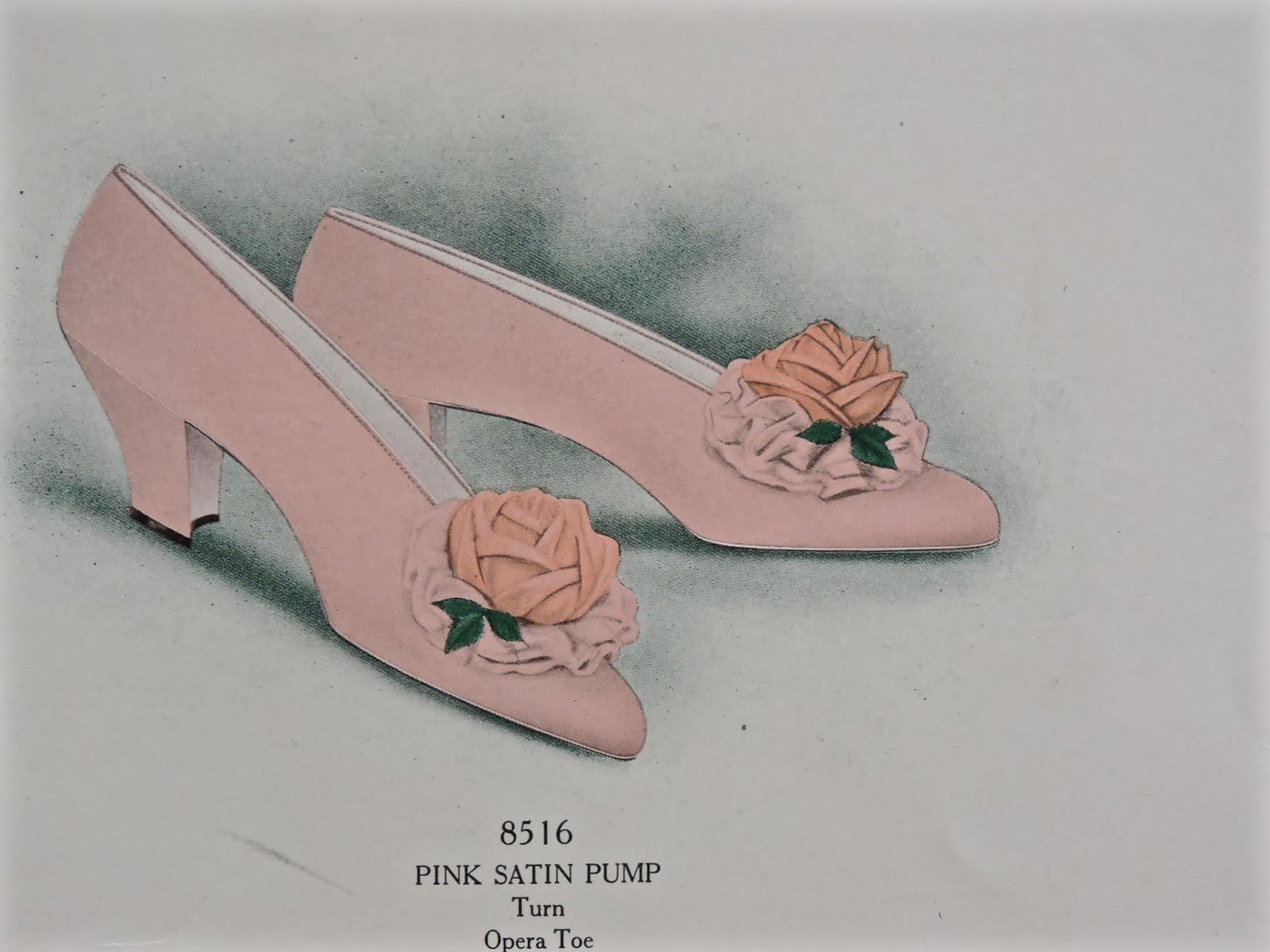
 At that time, the way to advertise was to send catalogs or flyers to businesses.  I am fortunate to have  several of his catalogs.  Some were fairly simple and others were rather elaborate.

 Here are a couple of my favorites:


I love to look at the shoes in the catalogs. There are shoes for women as
well as boots. I would love to wear either of these pink shoes.


Just look at all the colors those shoes come in.


I am not sure whether this is a shoe or a boot.  I love the buttons, but think it would take me a long
time to get them buttoned up.  Want to know how much they cost?  See that number at the button.  That is the price, but you have to read it backward.  The shoe/boot costs $1.60.


Wednesday, August 7, 2019

#191--Sisters--Staying Together


The theme for this week is sisters. My great grandmother, Charity Mears,  had five sisters, they are part of my ancestry tree that I call the tribe and that I have written about before.  I think of them as a tribe because they tended to stay together.

This time I want to look at who they married and see if there were relationships among their husbands.

So the first thing I needed was a listing of the sisters and brothers and their spouses, which I obtained from an earlier blog.

 Mary Mears ((1786-1873)—Lemuel Boyle Sayer
Elizabeth Mears (1796—1880)—Jonathan Shreve
Catherine Mears (1799-1888)—Robert Legate (1802—1822)  and  Israel Donnelson Sayre (1807-1849)
Nancy Mears (1801-1883)—George Newell (1798-1875)
Jane Mears (1803-1878)—Jesse Stephenson (1804—1828)and David Calvin (1800/1810—1845)
Charity Mears (1806—1842)—John M. Hannah (1799-1842)
Sarah Jane Mears (1808-1899)-- George Fisher (1807-190)
William Mears (1799-1873)--Sarah Newell (180--1873).


There are several last names in common.  Were they related? I found that Lemual Boyle Sayres and Israel Sayers were brothers.  They were born in Brown County Ohio to Dennis and Hester (Donaldson) Sayres. Lemuel Remained in Brown County, while Israel moved to Edgar County, Illinois.

The Newells--George and Sarah--were brother and sister.  They were both born in Brown County.  Their parents were William Morris and Sarah (Paul) Newell.  Goerge and Nancy moved to Deer Park Illinois.  William and Sarah lived in several places in Indiana and then Ripley, Iowa.

I do know know how common it was for two sisters to marry two brothers.  I think it might have not been unusual in areas where the population was not large and therefore, there would have not been many choices in terms of spouses. I would like to talk to them to find how why these marrages took place. 

Friday, July 26, 2019

#189--Easy--A Festival of Pictures


This week’s theme is easy.  For me an easy thing to do is to assemble some pictures around a theme.  So I decided to use some pictures that I have from my collections and from my cousin, Anna.  They are pictures of the children of John Wesley Hannah from the late 1800’s.  Anna discovered a scrapbook when cleaning out her grandfather’s house and it was filled with wonderful pictures.  Not all the pictures were labelled, but we sent the pictures back and forth until we were pretty sure who the people were. 


The first picture is a picture is a formal posed picture of John Wesley and Jennie (Willey) Hannah and their children.  Capt. John Wesley Hannah is on the far left, next to him is his only son, William Hannah, then Marinda Hannah (DeArmond) , Gertrude Hannah (Turner), Cora Hannah (Parke),  Anne Charlotte Hannah (Ross), lastly, Jennie Sophia Hannah.

The second picture is of William Hannah in his military uniform from Wentworth Acaademy.  I believe it was a school picture for the yearbook. 


This is one of my favorites.  Someone evidently got a pair of scissors and gave some hair cuts.  From left to right they are Gertrude, Tim and Toots.  Marinda and Cora, I believe did not like their names so they changed them to Tim (Cora) and Toots (Marinda) and they were known by those names until the day they died.


Growing up a little, here is one of William with his two sisters, Gertrude and Anne.


Lastly, I have one of Tim and Toots as teenagers.  I love their blouses and their ties. 


I would to talk to all of these relatives to find out what they remember about the pictures.  

Monday, April 29, 2019

#178--Genealogy Road Trip to Paris


Edgar County Courthouse


My blog this week is about a Road Trip, which I took when I first started doing genealogy.  The Hannahs lived in Edgar County, Illinois for about 40 years and Edgar County is not far from where I live—about a one day drive.  So I decided to visit.  John M. Hannah, farmed and I wanted to visit that land as well as the cemetery where the Hannah’s were buried and the cemetery where my 3rd great grandmother, Elizabeth Mears was buried.  I also wanted to do research in the Courthouse and Genealogical Library.

So on a Tuesday in June, I headed off to Edgar County because the Edgar County Genealogical Library and Society is open Wednesday, Thursday and Friday. On Wednesday morning I was at the Genealogy Library when it opened.  I spent that day exploring what they had in terms of resources—I looked at the History and Edgar County (which I discovered was for sale so I bought one for later reference), looked at indices of marriages and deaths, etc.  The librarians were very, very helpful in finding materials that they thought I might be interested in.  I also spent time with the person who put all the information on the internet for the Civil War Regiments from Illinois.  He was able to give me additional information, e.g. physical description of my great great grandfather.  For each day that I was in Paris, I stopped into the library and did a little research.


The next day was devoted to visiting the places I wanted to see.  One of the genealogy librarians drew me a map with very clear directions.  My first stop was the Light Carmel Cemetery, where my great great grandmother was buried.  I remember driving though a lot of corn fields to get to it and several farmer waving hi to me from their tractors as I went by.  Despite assurances that I could not miss the cemetery, I drove right by it (This was before the days of GPS).  Realizing my mistake, I turned around and there it was.  As soon as I got out of the car, I knew I had no clue where the grave was, so it time to walk by every grave stone and read it.  After about ten minutes, I found it.  There it was laying on the ground, broken off at ground level, and fortunately face up.  After taking some pictures, it was time to move on.

Next it was time to go see the farm land.  My directions told me to go down a particular road—I cannot remember the number, and when I came to the curve in the road, the land would be to the right.  Amazing, I found it, got out of the car and took more pictures.  It was still a working
farm.
Farm Land


Hannah Plot
Then I went on to Chrisman, which is a little nearby town where I had some lunch. There was not much there for me so I moved to Paris, Illinois where I visited the Hannah plot in the Edgar Cemetery.  The money for land for the plot, the large oblique, and headstones was contained in Abertine Hannah’s will.  Here were the remains of people I actually knew something about.  Further down, there tombstones from other branches of the family.

After that I went back to my motel room, rested a little and had diner at the Paris Family Restaurant where I had the best ever homemade strawberry rhubarb pie!

I spent most of the next day at the Edgar County Courthouse, a truly magnificent structure.  The clerk showed me where to find the land records and how to understand them.  The books the land records .were in were not able to be Xeroxed, so for each transaction for John M. Hannah, and his children, I had to write down such information who John Hannah bought the land from or to, where the land was in terms of township and range, etc.  There were well over forty transactions so that took a lot of time.  I also recorded transactions for his sons, John Wesley and George Newell, and daughter, Albertine.  After the land records, I got the probate records for John M. Hannah and Albertine Hannah.  That was enough for that day.  I went back to my motel room and spent some time reviewing what I had accomplished and making sure I had not forgotten something on my to do list.  After that barbeque for dinner.

My first genealogy trip was over; it was time to go home and analyze all the information I gathered.  Before I did that, however, I stopped at the Genealogy Library to thank them for their help.

Monday, April 8, 2019

#175--James Hannah and Thrulines


The theme for this week’s genealogy blog is DNA.  Last week I wrote about Andrew Jackson Hannah, who I found through my DNA on Ancestry.com.  So this week I wanted to go in a different direction.  Ancestry recently changed its genealogy circles to ThruLines.  According to their web site it “shows how you may be related to your DNA matches through a common ancestor.” To do this, ThruLines takes the family trees of DNA matches and your tree combines them into one tree for one ancestor.  I decided that I would explore Trulines.

The opening page is arranged by generations:  There is a series of boxes.  On the first line is your parents, second line, their parents, then their parents, etc.  It will go back as far as your tree goes.  Those you are definitely related to are enclosed in a solid line box and those you may be related to are enclosed in a dashed line box.  When you click on an ancestor’s box, you get a descendant’s tree or a list of people who are in the tree.  For each individual, it tells you how the person is related to you, e.g. second cousin, and the number of centomorgans you share across a how many segments.


I decided to focus on my James Hannah line, because it is a line that is pretty complete, has a number of people in it and most importantly because I am pretty familiar with it.  When I clicked on James Hannah, the first thing it told me was that I had 44 DNA matches through James Hannah.  It listed five of his children—James, John M., Jane, Andrew and Henry, along with their children.  When I clicked on one of the children, e.g., James, I got his children along with their relationship to me and how many centomorgans we share.  As I clicked, there were indeed some descendants I did not know about and I could include them in my tree, but not before checking out the documentation for the person.  As I looked at the information available in the tree, it appeared to be very accurate.  However, I was disappointed that five of his eleven children were not included as no DNA was available.  Hence, I did not learn anymore about William, Nancy, Rebecca, India Ann, Mary, and Elizabeth.  However, in the future one of their descendants may do their DNA and appear in Thrulines.

As I looked through the Thrulines, I noticed one in a dashed box for a William Hanna, a person I did not know about.  When I clicked on him, Thrulines indicated he was my fourth great grandfather and I shared 26 DNA matches with him.  The first thing I did was look at his descendants.  My James
Hannah was not listed among them!  There was a James two generation down, but the birthdate was way off.  That was disappointing, but some of the information was useful.  The family was located in Newry, Northern Ireland, which I had seen before.  There was a reference to a source called Irish Pedigrees, Vol II, which had a section on the Hannas.  I will go back and read it very carefully.  Was Thrulines correct that this was my fourth great grandfather, no. not at all.

Thus far, I like Thrulines very much.  I am a visual person and being able to see everything laid out in a diagram is helpful to me.  Also I like being able to look at the sources on other people’s trees to see what they have to offer.  However, I would be very cautious.  I found one tree where the children listed were born from the early 1600’s to the mid 1700’s.


Monday, April 1, 2019

#174--Andrew Jackson Hannah and his brick wall


This week’s theme is a brick wall, a spot in your genealogy where you can go no further with a particular ancestor.  Sometimes that is not a problem as I do not want or need any more information and sometimes it is.  I have several brick walls and my most current one is Andrew Jackson Hannah (1818—19xx).  I found him while I was looking at my DNA matches.  Another woman and I share 22 centimorgans across two segments, making us fourth cousins to sixth cousins, according to Ancestry DNA.  As I understand it,that means that our common ancestor could be at the least at the great great great great grandfather level.  That also means I have been look in all the wrong places,
e.g. not far enough back.  Unfortunately, that is further back than either of the trees with Andrew Jackson Hannah in it goes, but provides me with a clue that I need to look at my 3rd great father and see what I can find in terms of his parentage.

But first, what do I know about Andrew Jackson Hannah?  What I know may help me figure out where to look.  He was born in 1816 in either Brown County, Ohio or Kentucky, although one person
thought it might be Pennsylvania.  He had a brother William, who was born in Ohio, and perhaps a sister, Jane.  He married Margaret C. Dunlap in Robinson, Pennsylvania, in 1850.  Margaret died in 1856.  She and Andrew Jackson Hannah had three children.   He then married Martha Jane Weaver and they had 11 children.  He lived in various counties in western Pennsylvania until 1875 when he moved to Ohio, Kansas.

So now I have three places to look—Brown County, Ohio, Kentucky, and Western Pennsylvania. All places where folks in my Hannah line have lived.  I have looked at all the Hannahs in Brown County and the two adjacent counties and can find no connections.  I have started reading A History of the Hanna Family by Charles Elmer Rice about the family of Robert Hanna and Elizabeth Henderson, who came to the colonies in 1763 and settled in Pennsylvania.  Several of their sons settled in Kentucky and Indiana.
It will take me a while to sort this group out, but I may find something useful.  There are two clusters of Hannahs in western Pennsylvania, one cluster is found in Hannastown, founded by John and Robert Hanna, and the other in Westmoreland/Armstrong county.

So I am slowly making a little progress, mostly by eliminating people.  Just wish I could talk to Andrew Jackson Hannah and ask him about his parents.