Welcome to my genealogy blog. Ancestors I Wish I Knew is a combination of genealogical information and stories about individuals in my family tree. The focus is on those from my Cochrane, Eitelbach, Merrett, Minarcik and Richards lines and their descendants.

Showing posts with label immigration. Show all posts

Thursday, January 18, 2018

#112--Abrahan Newell, Jr, Has a Lot of Candles on His Birthday Cake


I had never really thought about who was the oldest person in my genealogy, but the challenge for this week is longevity.  To do this I first had to figure out how old people were when they died.  Fortunately Family Tree Maker did that for me.  Out of the four people who reached the age of 100, I picked Abraham Newell, Jr, because he is most closely related to me.  He is my 7th great uncle. 

Abraham Newell was born in 1626 in Ipswich, Suffolk, England.  His parents were Abraham and Francis (Foote) Newell.  At the ae of 8, Abraham came to Massachusetts on the ship Lyon with his parents and five brothers and sisters.  They family settled in Roxbury, Massachusetts.
On February 18, 1651, Abraham Married Susanna Rand in Roxbury.  They had 12 children: Joseph Newell 1651–1651; Abraham Newell 1654–1726; Susanna Newell 1656–1729; Joseph Newell 1658–1718; Mary Newell1661–; Thomas Newell 1663–1674; Elizabeth Newell 1666–1683; Rebecca Newell 1667–;Ruth 1 Newell 669–; John Newell 1672–1673; Robert Newell 1674–1741; Thomas Newell 1675–1675.

Despite my best efforts I could not find much on Abraham at all.  He does not appear in the History of Roxbury or in the Church Records.  The only mention of him I could find was in his father’s will.  In that will, he states that he has given his son, Abraham several parcels of land and 20 pounds at his marriage and that that shall be considered his double portion of the land owned by his father.  Further, that his wife shall be able to live with any of her children that she wants to, but that Abraham should pay twice what his brothers pay for her support.  Also, once his wife dies, Abraham shall “enjoy the nowle” by the hill near his house, that he build where his father’s house was burnt. 

Abraham Newell, Jr. died on October 9, 1726, in Roxbury, Massachusetts, at the impressive age of 100.

Sunday, January 7, 2018

#110--James Hannah's New Start


The 52 Ancestors in 52 weeks challenge by Amy Johnson Crow is back.  It helped me in the past organize and move my genealogy forward so I have taken on the challenge again.  The prompt for this week is “Start.”  I had difficulty figuring out how I was going to start.  I finally decided to blog about one of my ancestors, James Hannah, who came to the United States to “start” a new life.  Previously I have blogged about finding his will,  the contents of the will, and what he owed, but not what little I know of his life.

James Hannah, my 4th great grandfather, was born in 1772 in Northern Ireland, probably in County Down.  Family lore states that he was the younger son of a family that owned a bleaching green.
There is no record of how or when he came to the United States.  However, I assume like most of the Scotch-Irish, he landed in Philadelphia or Chester, Pennsylvania.  He married Nancy McKee in 1795.  Her father at that time was living in New Garden, Chester in Pennsylvania so I think they were probably married in that vicinity.  James and Nancy had 11 children.

By 1800, James Hannah had moved his family to Buffalo Township, Armstrong County, Pennsylvania.  In the census for that year, James Hannah is listed as having 4 children.  By 1810, the family was living in Sugarcreek Township, again in Armstrong County.  The family had now grown to five boys and two girls.
James fought in the War of 1812.  In April 25, 1813, James enlisted for six months.  According to the Pennsylvania Archives, he served with Captain Scott's Company of the Fourth Battalion, Washington County, Pennsylvania.  I have a letter from one of my grandfather’s cousins, in which he states, that James always had trouble with his feet because they froze during this war.

I know that those who served in the War of 1812 were eligible for land grants in the Virginia Military District.  I cannot find whether or not James received or purchased one of those grants or bought land directly one from someone else, but by 1820, he was living in Pleasant Township, in Brown County, Ohio.  That letter I have also says that he brought his family from Sugarcreek to Brown County by coming down the Ohio River on a flat boat.

The duplicate tax records for Brown County are on line at FamilySearch.org.  While not searchable by name, it is possible to find your ancestor, as the records are alphabetical by year and sometimes by township.  James is in some of the tax records from 1820 to 1827.  He is not listed for 1823 and 1825.  I believe he was actually there, but since this is a hand-written copy of the actually records, he may be misidentified or skipped. His total taxes ranged from 13 cents to $1.10.  The record indicate that he owned 15 acres of land.

James died in1828 in Brown, Ohio, at the age of 56. There is no record of where he is buried.  I previously blogged about his will.  While the census at that time did not state an occupation, from his will, I think it is pretty clear that James farmed.

If I could talk to James, I would have several questions for him.  First, where was he born in Ireland and who were his parents?  Second, why did he immigrate to the United States? Third, why did he move to Ohio?


Thursday, December 8, 2016

#96--Moving with the Mears


OHIO MAP WITH BROWN COUNTY 
My last blog was about the way my great-great grandmother, Charity Mears, named her children. While working on that line, I noticed another interesting things about Charity Mears and her sisters.  I had always heard that families moved from one place to another because they know someone there or believed it would be a better place. With the Mears sisters I could see it in action.

When the sisters married, they all lived in Brown County, Ohio.  Here is a list of the sisters and their husbands.
 Mary Mears ((1786-1873)—Lemuel Boyle Sayer
Elizabeth Mears (1796—1880)—Jonathan Shreve
Catherine Mears (1799-1888)—Robert Legate (1802—1822)  and  Israel Donnelson Sayre (1807-1849)
Nancy Mears (1801-1883)—George Newell (1798-1875)
Jane Mears (1803-1878)—Jesse Stephenson (1804—1828)and David Calvin (1800/1810—1845)
Charity Mears (1806—1842)—John M. Hannah (1799-1842)
Sarah Jane Mears (1808-1899) George Fisher (1807-1907).


As I looked at the census information for these families, I noticed that they began to leave Brown County for places that were further west.  The first couple to leave were Jonathan and Elizabeth Mears Shreve who by 1820 had moved to Ripley County, Indiana, where Jonathan’s father now lived.
I knew that by 1830, my great grandparents, John and Charity Mears Hannah were living in Edgar County.  However, according to the census for 1830 George and Sarah Jane Mears Fisher and Israel and Catherine Mears Sayre were also living there.  But that was not the only Mearses who were in
TOWNSHIP MAP OF EDGAR COUNTY 
Edgar County.   I also knew from her will that Elizabeth Mears, the mother of all the Mears girls, was in Edgar County at the time of her death in 1842.   Further Jane Mears Stephenson, whose husband died in Brown County in 1828 also came to Edgar County as she married David Calvin there in 1833.
One couple did not go to Edgar County, even though they did leave.  George and Nancy Mears Newell stayed in Brown County until 1860 when they were in Deer Park, LaSalle, Illinois.  They remained there until their deaths.  While all her sisters left Brown County, Mary Mears with her husband Lemuel Sayre remained in Brown County.

So why might these families moved to Illinois?  I think the answer is land.   For each family I searched the Illinois Land Sales and found that each husband and Elizabeth Mears bought land.  Generally land was bought on a land warrant or for $1.25 per acre.  As I looked over the purchases they were all in the same area—Townships 15 and 16 in Ranges 11 and 12.  That would mean these families were living relatively close together in Ross, Prairie, Edgar or Brullet.  That area is the four townships in the upper right hand corner of the map.  Someday soon, I will take that township map and plot exactly where the land was purchased.

If I could talk to them, I would ask why they moved.  I would also like to know how they travelled from Brown County to Edgar County.  Did they go over land?  Did they go down the Ohio River and then up the Wabash River?  Or did go partly down the Ohio and then overland to Edgar County?

Thursday, November 10, 2016

#94--From There to Here--The Richards, Hannahs, Minarciks and Eitelbachs Arrive


I recently flew to and from Europe.  It took about 8 hours to get to Spain and about 10 hours to fly back from Rome.  During those flights, I thought about my ancestors who came to America and what they may have experienced.  They arrived along before airplanes crossed the ocean so I decided to go back and look at the ships that they took to get here.  I also decided to focus on my four main lines—Richards, Hannah, Eitelbach and Minarcik.

Edward Richards is my earliest immigrant ancestor.  According to Cutter in “New England Families, Genealogical and Memorial, V. 2., Edward Richards came from England about 1632.  While not listed on the ship manifest, he is presumed to have come on the Lyon with his brother Nathaniel.  The Lyon sailed from London on June 22 and arrived in Boston on September 16.  While they were on the ship for 12 weeks, for only 8 of those weeks were they at sea.

James Hannah is my next immigrant ancestor to arrive.  However, I have not been able to figure out exactly where or when he landed.  I do, however, have some idea of when he might have immigrated. The earliest document that I am able to locate is an 1806 application for a land warrant in Armstrong Count, in which James swears that he and his family settled on the land in 1799, built two cabins, cleared the land and planted crops.  Andrew Mckee, his father-in-law, and Phillip Anthony both swore that James Hannah had lived there for at least five years.  Further, his oldest child, James Hannah, consistently states that he was born in 1795.  So my best guess is that James landed in the Philadelphia area some time before 1795, married Nancy McKee and along with his father-in-law and his family moved to Armstrong County.  At that time, it took 7 to 8 weeks to cross the Atlantic.

.Le Havre in the 1850's
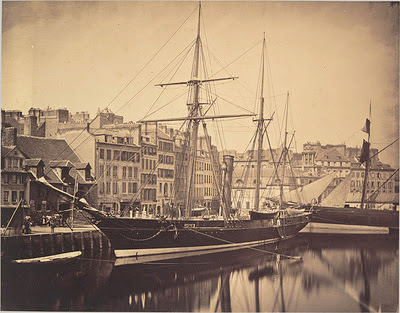
My third group of ancestor were the Minarciks.  On June 27, 1854  Joseph Munarzick with his wife, Regina and two children—Elizabeth and Carl—arrived in the port of New York.  They sailed from LeHavre, France on the ship William Tell, a 3-masted, square-rigged sailing ship on May 21.  The
William Tell arrived in New York on June 27.  The voyage lasted 38 days. According to the ship manifest, there were 618 passangers on board along with cargo.  Interestingly, Regina Munarizick’s parents, John and Catherine Wende along with their children—Marie, Catherine, Carol, Susan and John—were on the same ship.

Rhyland
The last to arrive there the Eitelbachs.  They sailed on the Red Star Line’s Rhynland, a four-masted steam ship.  While I cannot pin down exactly when they left Antwerp, they arrived in New York on May 23, 1895.  The Red Star Lines’ web page indicates that the voyage typically  took from 7 to 10 days, so they should have left sometime between  May 13 to 16.  Looking at the passenger list, I learned that they came third class or steerage, their quarters were in the stern of the ship and they brought 5 pieces of luggage with them.  I also saw that Louis described himself as a locksmith.

So over the course of about 400 years, the amount of time it took to travel from Europe to the United States dropped from 8 weeks for Edward Richards to 38 days for the Minarciks, to 7 to 10 days for the Eitelbachs to my 10 hours.  I know what my trip was like, I would like to know more about theirs.

Tuesday, August 16, 2016

#91--The Eitelbachs at Ellis Island

Ellis Island


When I was in New York City in May, we visited Ellis Island.  There are several different tours.  We took the one the focused on the experience of being an immigrant coming to New York.  I was particularly interested in doing that one because my great grandparents, Louis and Marie (Huelster) Eitelbach came through Ellis Island on May 1895 with four of their children, Walter, Louis, Maximillian and John.  That visit inspired me to further research their experience.

When I thought of them coming to American, I always thought their arrival.  So I decided that my research need to begin with their leaving Germany.  If they followed the typical pattern of immigrants, Louis Eitelbach contracted with a local steamship agent, who made the arrangements for their immigration.  That would have included transportation to the port, a hotel room while waiting for the ship to sail, if necessary, and passage on the steamship.  Many Germans left through Bremerhaven or Cuxhaven (Hamburg).  However, that was not true for the Eitelbachs.  They sailed from Antwerp,
on the Red Star line ship, the Rhylander.  Why Antwerp?  It was the port that was closest to Barmen, where they lived.  Before they were able to board the ship, they would have had to pass a medical examination and answer a series of questions.  That process insured that they were fit to enter the United States.  If the immigration authorities at Ellis Island denied anyone entrance, the steamship company had to take them back to Europe at the steamship company’s expense.

In the family that keeps sentimental things, I have my grandfather’s ticket locked in my safety deposit box. I cannot find when they departed, but I know from the passenger list that they arrived on May 23, 1895.  According to the Red Star Line’s webpage, the voyage took from 7 to 10 days, depending on the weather.  Looking at the passenger list, I learned that they came third class or steerage, their quarters were in the stern of the ship and they brought 5 pieces of luggage with them.  I also saw that Louis described himself as a locksmith.

Passenger List

Once the ship arrived in New York, the Eitelbachs would have been taken by ferry to Ellis Island. The ferry was divided into sections and the letter they were given, told them which section to stand in.  Once at Ellis Island, they would have been directed to the main building.  Right inside the door was the baggage room, where they would have had to have left their five bags.  They, then, proceeded up the stairs to the Registration Room, also known as the Great Hall.  The Hall was divided into lines by railings.  Given the size of the room—200 feet long and 102 feet wide—and the very large number of people in it, all speaking different languages, the noise may have been overwhelming, especially for the two youngest boys, Max and John.

In the Great Hall, the Eitelbachs would have been quickly been examined by a doctor to determine if they were healthy enough to enter the United States.  Had the doctor had any suspicions that they
Great Hall
were not, they would have been sent for a more in-depth exam.

Next was the legal inspection.  A registration clerk, who had the ship’s manifest in front of him, would ask the same questions of each person e.g. name, age, occupation, destination, amount of money, the name of a friend or relative, etc. that they were asked when leaving Antwerp,  That was to determine if any answers were different.   I am pretty sure my great grandfather and great grandmother each answered the questions.  I do not know whether or not the children were questioned.  Since they entered the United States, I can assume that their answers were satisfactory. Once cleared, they would have gone back downstairs, claimed their baggage and probably met by a relative.  I do not believe that Louis Eitelbach had any relatives in New York.  However, Maria’s two brothers, Frank and Joseph, had both emigrated in 1893 and well could have been there to meet them.

I regret that I never talked with my grandfather about his coming to the United States.  I would love to know why they came, what the trip was like, what was their experience in going through Ellis Island, and who met them.

Tuesday, October 27, 2015

#75--Nathan Aldis--Oops I Lost You


This week’s blog theme is “oops.”  I have had lots of oopses while doing genealogy.  I have researched the wrong person, attached the wrong person as a spouse, and had multiple people, who turned out to be one person.   I have also misplaced paper docuemnts, only to discover them later. Several years ago, I decided that I would write some brief sketches about my emigrant ancestors.
I did do all of my Richards grandfathers.  Then, I began to branch out and do some of the collateral lines.  I guess something else came along that occupied my time and by the time I got back to genealogy, I had forgotten I written them.  Imagine my surprise when looking for something else to find them neatly written on a yellow pad.  So that is my oops for this week’s blog.  One of my bio was of Nathan Aldis, so for this week I am sharing his oops bio with you.

Nathaniel Aldis is my 8th great grandfather.  He was born in Fressingfield, Suffolk County, England about 1596 to Francis Aldous and Sarah (Mary) Gooch.  In 1638, he immigrate to the colonies and settled in Dedham with his wife, Mary and his children:  Lydia, Mary, Ann and John. He signed the Dedham Covenant and became a member of the church on February 11, 1640 and a freeman on May 13, of the same year.

Nathaniel Aldis was a selectman for two years (1641 and 1642). He was one of the first deacons of the Dedham Church.  He served as a member of the meeting house and pastor’s salary committees.  In 1642 he bought one sixth interest in the watermill in Dedham.  Seven years later, he sold that interest to Nathaniel Whiting.  He was the appraiser of several estates.  .  Nathaiel died on Mary 15, 1676.  His son, John, and his wife, Mary, were the executors of this estate of was valued at 223 pounds.  His wife, Mary died on January 1, 1677.

Tuesday, June 30, 2015

#64 William Cochrane--You Have Taken Up a Great Deal of Time

2015 is half over, so our theme this week has to do with halves.  I chose to blog about the ancestor that I feel has taken up about half my research efforts.  I am not sure that any of my ancestors has taken up half my time, but there are several who have taken up a great deal of time.  Edward Richards, my emigrant ancestor, comes to mind.  He settled in Dedham, Massachusetts in 1632.  I gathered a great deal of information about him from the town records.  Actually, it was pretty easy, but time consuming,  to get that information as the town records are very detailed.  So I decided I should blog about someone else who took time because of brick walls..

That person is William Cochrane, my great, great grandfather.  He has presented me with several
brick walls, some of which I have yet to break through and all of which have consumed time.  My first wall was to document his parents.  I had heard from my Aunt and Father that he was the cousin of Lord Thomas Cochrane, the England navel admiral. FromWilliam’s  gravestone I knew that he was born in 1810. To find his parents, I tried several things—First I looked at other people’s trees on line that contained a William Cochrane and checked the records in Family Search.  No luck.  Second I tried Burke’s Peerage, which while covering the family, but it did not list any William Cochranes in the right age range.  I knew that it was possible to order wills from the Prerogative Court of Canterbury.  So I ordered several in the hope that a William Cochrane would be listed as an heir.  While a good idea, that did not work either.  Serendipity often is a friend of genealogists and in this case the parish records for St. Marybone were added to Ancestry.  I searched them, and there he was—William Cochrane-Johnstone, son of Andrew Cochrane-Johnstone and Ann Morgan.  Further search of the parish records located his brother, Andrew George Cobett, who I knew about, and two siblings—George, and Anna Maria, who were new to me.  Part of the difficulty seems to me to be the fact that William’s father’s last name was Cochrane-Johnstone, however, William and his brother Andrew used the last name Cochrane when they were married in England and in their lives in the United States.

While I know from the New York State Alien Registrations that William was in Buffalo New York in 1836 and was married to Emma Merrett at Saint Andrews of the Wardrobe in 1834.
Exactly when in that two year period he and Emma arrived in the United States is another brick wall.  They are not included in the passenger lists of those arriving in New York City, in Philadelphia, or in the Castle Garden records.  Since Buffalo is on our border with Canada, at times, I wonder if they came in through Canada.

So I will continue on and off to hunt for William Cochrane’s arrival in the United States, and eventually I may find that information.  If I were able to, I certainly would ask him.

Tuesday, June 2, 2015

#60--Regina Wendel--New Beginning for Her and for Me.


This week’s theme is commencement or new beginnings.   This blog is a new beginning for me and for the Wendells.  I thought I would have a “new beginning” by research a line that I had pretty much overlooked before.  I picked my Wendel line, and specifically Regina Wendel, my great, great, great grandmother and her family.  They migrated to the United States so that is a new beginning for them, too.  I have done some research on Regina's husband, Joseph Minarzik (Blog #6--Joseph Minarzik—How Do You Spell That Name), but not Regina.

Battenberg Castle
Searches in Ancestry.com and Family Search.org provided me the information I was looking for.   I found Regina Wendel was born in Battenberg, Germany in 1825.  She was one of twelve children born to Johannes Wendel and Katherine Kohl.  On September 9, 1849 she married Joseph Minarzick.  I am still not sure about the date she and Joseph came to the United States.  However, Charles, their oldest son, in his application for an army pension swore that he was born in New York City in 1853.  So, they immigrated sometime between 1849 and 1853.

In the 1860 census, Joseph and Regina have 8 children:
.Tenement
Charles, Elizabeth, Cary, Susan, John, Maria, Louisa, and Kate.  They were living in the lower east side of Manhattan in the 17th District, Ward 22.  Joseph was working as a tailor.  Regina Wendel Minarcik died on June 18, 1878, three years after her husband died.

While I am saving them for another day, I also found two of her brothers, Konard and John, in New York City in the 1870 census.

If I could talk to Regina, I would like to know why she and Joseph decided to come to the United States and to live in New York.  I would also like to know about her experiences of living in a tenement in New York as well as about raising 8 children.


Tuesday, April 21, 2015

#54--Living a Long Life--Maria Huelster Eitlbach

This week’s theme is living a long life.  People in my family tend to live a long time so I had a number of ancestors to pick from.  Plenty of my ancestors lived into their seventies or eighties so I began to look for people who lived longer than that.  So I want you to meet Maria Huelster, my great grandmother, my Oma.

Schmallenberg, Germany
 Oma was born in Schmallenberg, Germany in February of 1865, one of four children of Johann and Maria Franciska Monig. In 1885, she married Louis Eitelbach.  They lived in Hagen, Germany until 1896 when they, along with their four youngest children—Walter, Louis, Maxmillian and William—came to the United States.  They settled in Brooklyn, New York at 1287 Greene Street.  After their arrival, Maria had two more children—Harry and Frank.  I often wonder how she managed six boys.  I do know one thing--My mother told me that when they were small, on Sundays, before they went to church, she would dress each one and sit him on the sofa with directions not to move until they were all ready and dressed. Then, they would go to church.  Maria’s husband, Louis, died in 1927 and after that she lived on her own.  In fact, she lived alone in her apartment until very shortly before she died.

Maria Huelster Eitelbach "Oma"
I do have some memories of Oma.  This is how I remember she looked.   I also remember that we  would go to visit her several times a year.  I do not remember much about those visits as I was rather young.  I do recall that she liked to speak German with my parents.  Her English was perfectly fine, but since both my parents had studied German in school, I think it was fun for all of them.  Oma also would come to visit us.  Here is a picture of her holding me when I was about two years old.
Oma and me
Every Christmas Oma would come and spent Christmas Eve with us.  We always sang Christmas carols that night and Oma would sing Silent Night and O Tannenbaum in German for us.


Oma died on November 3, 1958.  She was survived by her four sons—Walter, Louis, Harry and Frank as well as 13 grandchildren and 20 great grandchildren.  If my research is correct (and I believe it is), anyone in the United States who has the last name of Eitelbach is a descendent of Maria Huelster and Louis Eitelbach.  So if you are an Eitelbach, please contact me.  I would love to meet you.

Tuesday, March 24, 2015

#51 William Cochrane and Andrew George Cobett Cochrane—That Wall is beginning to crumble

I never cease to be amazed that a brick or two, or maybe even three, may fall off that brick wall when you least expect it.  When I was in Washington, D. C. last month, I looked at a number of sources trying to figure out when William Cochrane and Andrew George Cobbett Cochrane with their families arrived in the United States from England.  All I knew was that in 1835 they both filed Alien Registrations in Erie County New York, indicating that they intended to become American Citizens. I
also had found a passenger list which indicated that an Andrew Cochrane arrived in Philadelphia in 1833-34.  That Andrew Cochrane was born in the correct year, but was it the right Andrew Cochrane.? Try as I might, I could find nothing for William Cochrane in terms of passenger arrivals.  That wall was still up.

The other day I was again looking at the information I had on Andrew George Cobbett Cochrane and decided to take another look at his application for a passport.  It had a lot of information on it, including that he had been naturalized.  I was hoping that the naturalization papers might be attached so I looked at the next page.  No luck.  However, I am persistent and decided to look at the pages before his application.  There I found a passport application from May of 1872 for his daughter, Emma Cochrane Kingman.  In her application she states that she was born in England on September 39, 1830 and came to the United States at two years of age.  Depending on when Andrew and his family arrived, she could have arrived in 1833.  Further, the parish record of St George’s Bloomsbury indicates that her brother Andrew Charles was born on February 8, 1832 and was baptized on February 29 of that year.

Taken together, these facts point to the conclusion that the Andrew Cochrane who arrived in Philadelphia may indeed be the Andrew George Cobbett Cochrane, brother to my great-grandfather.  Now I need to see if his naturalization records contain the date of his arrival.

If I could talk to Andrew, I certain would ask when he came to the United States and where he and his family landed.  I also would ask whether or not his brother, William, came at the same time.

Wednesday, February 11, 2015

#48--Joseph Minarcik--You Came a Long Way

.
The theme for this week is  far away in either time or distance.  I have written two recent blogs about ancestors in the Middle Ages so I decided on distance rather than time.  First I had to figure out which ancestors came from  the farthest away.   I have three lines from Germany so I knew it would be one of them.  The Eitelbachs were from Hagen, which is 4,042 miles away, the Huelsters from Schollenberg, which is 4,080 miles and the Minarciks were from Winnweiler, which is 4,120 miles.  So if this is a contest, the Minarciks would win. 

Map Showing Winnweiler
Joseph and Regina (Wendel) Munarzik were my emigrant ancestors. Joseph and Regina were married on September 8, 1849  in  Battenberg, , Bavaria Germany.  I do not exactly when they came, but believe that they came to New York City sometime between 1850 and 1860.  I tried unsuccessfully to find them in the Castle Gardens database, but could not do so.  I am pretty sure they are there, but I have found that their last name has been spelled in a number of way (see Blog #6—Joseph Munarzik—How Do You Spell that Name?).    I know they were there in 1860 as they appear in the United States Census in New York City, with their 5 children.   

I had never heard of Winnweiler .  A couple of internet searches and I learned that it is in the Bavarian section of Germany, specifically in Donnersbergkreis municipality, south and west of Frankfort.  The population in 2008 was about 4600.  This is a very mountainous region, but also a very rural one.

I found a couple of pictures and was impressed with the beauty of the area.


If I could talk to Joseph and Regina Wendell, I would want to know why they came to the United States, what ship they came on, what the voyage was like, whether or not they came with other people they knew, and when they came.

Wednesday, January 7, 2015

#43 Abraham Newell—A New Start in a New World


Last year I responded to the Ancestry.com challenge to blog about one of my ancestors once a week. I did not quite make it to 52 ancestors, however, I learned a great deal about those I researched and had fun doing it.  This year, the challenge has changed to a weekly suggested theme, which I can focus on or not.  I am going to try to use the themes.

The theme for the first week is “having a fresh start.”  I think that anyone who moves to a new country or state is having a fresh start so I have a number of ancestors that got a fresh start.  My first impulse was to blog about James Hannah and how he came to Pennsylvania from Ireland.  Then I remember that I had blogged about him and what I wrote seemed pretty close to a fresh start  (See #27--JAMES HANNAH—Many Questions and few Answers) so I decided to try someone else.
Abraham Newell is my fresh start ancestor.  Abraham was born in England about 1584.  He came to Massachusetts on the ship Francis, arriving on April 24, 1634 with his wife, Frances and his children. Abraham, Sr. and his family settled in Roxbury, Massachusetts.

William Stark Newell in his books—The Ancestors of William Stark Newell—speculates as to the reasons that Abraham may have immigrated.  One speculation is that he came for religious reasons.   In England, the Puritans wanted to reform the Anglican Church and remove many of the practices left over from the Catholic Church, e.g., stained glass, statues, etc.  For those beliefs, Puritans were persecuted and as a result, came to the Colonies to worship as they wished to.  To support the idea that Abraham was a religious person and may have come for religious freedom, one need only look at the names of his children—Faith, Grace, Abraham, Jr., John, Isaac, and Jacob.  They are all biblical.  Second, Abraham joined the church in Roxbury the same year that
he arrived.  Thus, there is some reason to believe that Abraham may indeed have decided to move his family to Massachusetts for religious reasons.

Economic factors were another reason that individuals migrated.  Land in England was scare and inflation was high, making earning a decent living difficult.  If people moved to the Colonies, their chances for a better life improved. I have read that Abraham was a tailor.  At the time of his immigration, the wool trade in England was experiencing great inflation and wool was scarce.  Lack of cloth would have impacted a tailor’s ability to make a living.   Further, I do not know whether or not Abraham owned any land in England.  However, in the Colonies, land was free and with land ownership came the right to become a freeman and vote.  In Roxbury, he did own land.  The Roxbury Book of Possessions, dated about 1653 lists ten parcels of land that he owned.  If I add up the acres in them, Abraham owned 119 acres of land in various places
in Roxbury.  Using his will, from 1692, William Start Newell estimated that he had 153 acres plus some land in fresh meadows.  So it is also possible that Abraham Newell, Sr. came to the colonies for economic reasons.

It is not possible to know exactly why Abraham, Sr. came to the Colonies, however, both religious and economic reasons seems possible.  However, it looks to me that he got a fresh start—he could worship in a Puritan church and he owned land.  If I could talk to him, I surely would ask why exactly he decided to come.

Wednesday, December 31, 2014

#42 William Avery--Blacksmith, Physician and Bookseller

Everyone has a hobby or two that they like.  Aside from genealogy, books are another of my  ways to spent time.  I sort books for my local library’s book sale, am a member of two books groups, and always have at least one book that I am reading.  So you can imagine my delight to find out that one of my grandfathers, William Avery, was a bookseller in Boston.

William Avery was born in 1622, in Barkham, Berkshire, England, the son of Christopher and Margery (Stephens), Avery.  William married Margaret Allright.  They, together with their three children:  Mary, William, and Robert, came in 1650 to the Massachusetts Colony and settled in Dedham, Massachusetts.   He and his wife were admitted to the church on February 16, 1650.  He was a sergeant in the Dedham militia as well as the Deputy to the General Court.  He was a member of the Ancient Artillery Company.

 In the Dedham Town records, William’s was granted land to open his forge as a blacksmith; however, later he is referred to as Dr. Avery.  How one goes from being a blacksmith to a physician
to me is a mystery.  However, I think that his description as a physician is correct.  In 1853, Dr. Ebenezer Alden, who was them the President of the Norfolk District Medical Society said “Dr. William Avery was the earliest educated physician, who is known to have taken up his residence in Dedham. “  Further on in the town records, his son, William Avery, Jr. is also described as a blacksmith.  I think that he was a physician who started a blacksmith shop with the intent of turning it over to his son.

Margaret Avery died on September 28, 1678.  Shortly thereafter, William moved to Boston.  Despite his move, in 1680 the Dedham Town Records state  that “Capt. Daniel Fisher and Ensign Fuller report that Dr. William Avery, now of Boston, but formerly of the Dedham Church, out of entire love of  his Church and Town, freely give into their hands, sixty  pounds, for a Latin school, to be ordered by the Selectmen and elders. “

So how did William Avery become a book seller?  Shortly after moving to Boston, William married Maria (Woodmansey) Tappin, whose son was running a bookstore.  William took over the store and added an apothecary department to it.  In 1679 in the History of Printing, the store is described as being near sign of the Blue Anchor.

William died on the 18th of March 1686.  He is buried in the burial ground of King’s Chapel in Boston.  Several years ago I was in Boston, so of course I had to go and visit his grave.  A very helpful Park Ranger (King’s Chapel is a national park) showed me a map of the graves and noted that the headstones had been moved at some point so while he is buried there, he probably is not buried beneath his gravestone.  I had no trouble find the site as it is directly to the right to the gate to the graveyard.


His gravestone reads: 


Here lyeth Bvried
the body of
WILLIAM AVEARY
aged abovt 65 years
died Mearch the 18th
1 6 8 6

Wednesday, July 23, 2014

#24 William Cochrane—Finding a New Home


My blog this week is about William Cochrane, my great-great grandfather.  I do not know a great deal about him and what I have has pretty much been gathered from various sources on the web.  I do have his picture, which was sent to me by my cousin, Mary.  While I wish the picture was clearer, he reminds me in some ways of my father.

William  was born on October 18, 1810 in London England to The Honorable Andrew James Cochrane and Ann Morgan.  Andrew had two brothers, Andrew George Cobbitt (See Blog #3) and George, and one sister, Anna Maria, all born in London.   In 1830 on January 19, he married Emma Merrett at St. Andrews of the Wardrobe.  William and Emma had six children:  Mary Jane (1836—1920), George Augustus (1838--??), Emily (1840-1911), Walter (1843-1891), Emma (1846—1931), and Evalina (1853—1920).

In the mid 1830’s William and Emma migrated to the United States and settled in Buffalo, New York.  At that time, his brother, Andrew George Cobbett Cochrane also lived in Buffalo.  I do not know whether the two brothers and their families came together or separately. However, in 1835, he filed a declaration to become a citizen of the United States.  By 1840 William had moved to Rochester, New York, where his occupation was listed as an upholsterer in both the 1840 and 1850 Census.  In 1860 and 1870 he and his family were living at 124 Fort Greene Place, Brooklyn, New York.  His occupation was now listed as a bookkeeper at Journey Burnham, a department store. By 1870, Mary Jane had married Abiathar Richards and they along with their two sons, Chester and William were living with her parents.  Also living there were Emily, Emma, and Evalina.  Both George and Walter had married and started their own households.
William died on July 20, 1873, while Emma died on September 1, 1882.  Both are buried in Green-Wood Cemetery in Brooklyn, New York.

Were I able to talk to William, I would ask about why and when he came to the United States as well as why he eventually settled in Brooklyn, New York.  His mother, Ann Morgan, is one of my brick walls.  So I would like him to tell me about her and who her parents were.

Monday, March 24, 2014

# 7 The Picture on my Wall—Louis Eitelbach


       Several years ago, I found this picture of my great grandparents, Louis and Marie Eitelbach.   They are all dressed up, maybe for a Sunday afternoon walk in the park, maybe just to have this picture taken.  I love my great grandmother’s parasol and my great grandfather’s walking cane.  The picture was framed so I added it to my gallery wall along with other pictures of my ancestors.  Louis Eitelbach is the subject of this week’s blog.

      He was born in Hagen Hamm, Germany in July 1864, one of seven children of Nicholaus Augustus and Helena (Agatz) Eitelbach.  In 1885 he married Maria Berta Huelster.  While in Germany they had four children:  Walter, Louis, Maxmillian and William. 

     On May 25, 1895 Louis arrived in New York with his wife and four children.  They sailed from Antwerp on the Red Line ship, Rhyland.  According to the ship manifest, their destination was Brooklyn, New York.  The 1900 census indicates that they were living at 1287 Greene Street, Brooklyn and two additional boys, Harry and Frank, had been added to the family.   By 1910 the family had moved to 152 Napier Street, Queens, New York and in 1920 lived at 8766 109th Street, Richmond Hill, Queens, New York.  While it appears that the family had moved, actually Napier Street was renamed 109th Street.   The ship manifest lists Louis occupation as a lock smith; in all three censuses his occupation is given as a machinist in a tool shop.   Louis died on December 26, 1926.


     If I were able to speak to him, I would ask about the picture.  When was it taken?  Where were they?  Why did they take it?  

Sunday, February 23, 2014

#3 Andrew George Cobbett Cochrane

#3 Andrew George Cobbett Cochrane  

This week’s ancestor is  Andrew George Cobbett Cochrane.  He is my great, great uncle, brother to my great, great grandfather, William.  I had heard various stories about him from my father and my aunt, particularly that he would come to Brooklyn to visit his brother and his family and how they would go to Manhattan to the theater and other performances.  I also heard that my grandmother met her husband when she visited her cousin, Lucy Cochrane, who was one of Andrew’s daughter.  I thought it would be interesting to know about him and his family.  In doing so, I was impressed with the amount of information that was available in the Buffalo city directories. 
                Andrew George Cobbett Cochrane was born on May 12, 1809 in London, England.  His parents were The Honorable Andrew James Cochrane and Ann Morgan.  Andrew had two brothers, William and George, and one sister, Anna Maria, all born in London.   In 1828, he married Emma Shaw at St. James Church, London, England.  According to the baptismal records for his daughter Emma, in 1830, the family lived on Museum Street, in London, and from the records for his son, Charles,  in 1832,  on Court Street.  Both records indicated that Andrew was an assistant overseer. 
In 1835, Andrew and his family and his brother William and his wife immigrated to the United States and settled in Buffalo, New York.  According to the census and the City Directories for Buffalo, Andrew was a bookkeeper.  From 1836 until 1855, Andrew worked for a variety of different companies, e. g,, Holt, Palmer & Company;  E. Norton; and Kinne, Davis, and Company.  Beginning in 1855 and until his death, Andrew was the general account for the American Merchants’ Union Express Company, which I believe was the forerunner of American Express. 
                Andrew and Emma had five children:  Emma born in 1830; Andrew Charles, born in 1832; Lucy, born in 1834; William, born in 1838; and Edward Chester, born in 1843.  The census for 1840 show that Andrew was living in Buffalo  in a house with 15 other people.  I suspect that his and his brother’s families were living together, but who the additional people were is a mystery.  By 1850 Andrew was living with his wife, and children, Lucy, William and Edward.  In 1860, Andrew and his wife were living with Andrew, Lucy, William, and Edward.  In addition, Emma, her husband, Amasa Kingman and their four children, were also living with them.  By 1870, all the children were married and living out of the house with the exception of Charles, who is described as away at school. 
                The City Directories for Buffalo list the associations, organizations, and churches as well as the individuals who held offices in them.   In 1837, Andrew was the recording secretary of the Young Men’s Association, a literary society, which is described as having a “well-selected” and large library of books and was the forerunner of both the Buffalo Public Library and the Buffalo Museum of Science.  A year later, he was still the recording secretary, but also on the library and by-laws committees.  In 1847-48, he was the Assistant Secretary of the St. Andrews Society, a group for those of Scottish descent; a notary public,  and the Deputy District Grand Master of Erie District #3 of the Odd Fellows.  From 1847 to 1849, he was a trustee of the Unitarian Church. 
                While I would like to have a picture of Uncle Andrew, the best I can do is the description on his passport application when he was 62.  He is described as 5 feet 8 and ½ inches tall with grey eyes, gray hair and an oval face. 
                Andrew died on May 28, 1872.  He along with his wife is buried in Forest Lawn Cemetery in Buffalo, New York.

                If I were able to speak to him, I would ask why he and his brother decided to come to the United States and particularly to Buffalo.  I also would like him to tell me about his mother.  She is one of my brick walls.