Welcome to my genealogy blog. Ancestors I Wish I Knew is a combination of genealogical information and stories about individuals in my family tree. The focus is on those from my Cochrane, Eitelbach, Merrett, Minarcik and Richards lines and their descendants.

Tuesday, January 30, 2018

#114--Were the Eitelbachs in the Census or Not?


What did you find that was interesting in the census is the theme for this week.  However,   I decided to take different tack on that and blog about who I initially could not find in the census.

The census is a wealth of information.  You can learn who lived in the house, how old people were, their occupations, etc.  For the 1930 census you can even learn if they had a radio. However, learning all that depends on being able to actually find the person or people you are looking for in the census.  It should be relatively easy these days.  Both Ancestry and Family Search have searchable indices,
which should identify people who match your search criteria.  That, of course, all depends on the person being accurately listed in the census and transcribed into the index. 

My grandparents’ last name was Eitelbach, a good German name and unfortunately for me one that can be misspelled or mistranscibed in many different ways.  As I began to gather together census information for them, I found my grandfather, Walter, living with his parents in the 1900 census.  He married in 1908 so he and his wife should have been in the 1910 census.  No such luck—no Walter or Regina Eitelbach.  With a little creativity  I found them—Walter and Regina Citelbach, victims of handwriting extending into the line above.  It did not get any better in the 1920 census.  Now they were the Latelbaths.  In the 1930 census, the name was spelled correctly, and made my life easy.  By 1940, they were the Bitebachs

When I could not find them, what did I do?  I changed my search criteria.  I used first names only, years born, where I thought they lived, etc.  For the 1940 census, I knew who lived next door so I
search for that family. 

If I could talk to them, I would be interested to hear how much difficulty the spelling of their name caused them.  Was it generally a problem or just in the census? 

Friday, January 26, 2018

#113--Sunday Dinner at Nana's


This week’s Challenge theme is dinner.  So many ways to go with this.  I considered blogging about a person I would like to invite to diner-- that would give me a chance to ask a lot of questions and fill in some blank spots.  However, since the person would not be there, I would get no answers.  Then, I thought about Sunday dinners.  Dinner on Sunday with your family seems to be a tradition that no longer exists.  But it did when I was growing up, so I decided to write about Sunday dinners.

When I was a child, every Sunday we had dinner with my grandmother, Regina Eitelbach.  Nana lived about 30 minutes away so we drove and spent the day.  I did not realize it at the time, but she was an outstanding cook.  Anything Nana made was always delicious. She always made a full meal and served it on her best china.  I remember my father carving the meat, the bowls of vegetables and potatoes on the table.  However, what I remember best is dessert.    Nana’s deserts were the highlight of the meal--apple pie, lemon meringue pie, chocolate layer cake with chocolate frosting, shadow layer cake, and yellow cake with coconut frosting.  At Christmas, Nana made butter cookies with a cookie press, rolled and frosted cookies as well as German leubkeuken. 

Sometimes when I visited, Nana and I would bake, usually cupcakes.  I loved to frost those cupcakes in all kinds of colored frosting.  The blues ones were my favorites, and I thought tasted the best. I have some of her recipes, but I have not been too successful in making them.  While I know that butter the size of an egg is a quarter of a cup, 2 cups of flour and enough more so it feels right is beyond me.  I have no idea what it should feel like.  Unfortunately Nana died before I was really old enough for her to teach me how to bake. 

I would love to talk to Nana again.  I would ask her how she learned to cook and bake, and what some of her favorite recipes were.  I think I also would ask for a lesson on baking.

Thursday, January 18, 2018

#112--Abrahan Newell, Jr, Has a Lot of Candles on His Birthday Cake


I had never really thought about who was the oldest person in my genealogy, but the challenge for this week is longevity.  To do this I first had to figure out how old people were when they died.  Fortunately Family Tree Maker did that for me.  Out of the four people who reached the age of 100, I picked Abraham Newell, Jr, because he is most closely related to me.  He is my 7th great uncle. 

Abraham Newell was born in 1626 in Ipswich, Suffolk, England.  His parents were Abraham and Francis (Foote) Newell.  At the ae of 8, Abraham came to Massachusetts on the ship Lyon with his parents and five brothers and sisters.  They family settled in Roxbury, Massachusetts.
On February 18, 1651, Abraham Married Susanna Rand in Roxbury.  They had 12 children: Joseph Newell 1651–1651; Abraham Newell 1654–1726; Susanna Newell 1656–1729; Joseph Newell 1658–1718; Mary Newell1661–; Thomas Newell 1663–1674; Elizabeth Newell 1666–1683; Rebecca Newell 1667–;Ruth 1 Newell 669–; John Newell 1672–1673; Robert Newell 1674–1741; Thomas Newell 1675–1675.

Despite my best efforts I could not find much on Abraham at all.  He does not appear in the History of Roxbury or in the Church Records.  The only mention of him I could find was in his father’s will.  In that will, he states that he has given his son, Abraham several parcels of land and 20 pounds at his marriage and that that shall be considered his double portion of the land owned by his father.  Further, that his wife shall be able to live with any of her children that she wants to, but that Abraham should pay twice what his brothers pay for her support.  Also, once his wife dies, Abraham shall “enjoy the nowle” by the hill near his house, that he build where his father’s house was burnt. 

Abraham Newell, Jr. died on October 9, 1726, in Roxbury, Massachusetts, at the impressive age of 100.

Saturday, January 13, 2018

#111--Louis Eitelbach--I Think I Will Have a Beer


The 52 Ancestors challenge for this week is a favorite picture.  Now those of you who know me know that I love old pictures and that I have a lot of them.   In fact, I have blogged about several of them before and this is one of my favorites.  So my problem for this challenge was to pick just one picture. 

I went through a box of pictures that I inherited from my grandfather.  This picture of my great grandfather, Louis Eitelbach, was the one that I finally selected.  What a fun picture.  There he is, all dressed up and sitting on a keg of beer! I love that he wearing a bow tie, pocket watch with chain, and what looks like a flower in his label.

I have no idea where or why the picture was taken.  I do know, however, that there was a large number of Germans living in Brooklyn, where Louis and his family lived and that they had a variety of clubs and activities.  I assume that this picture was taken at one of them. For more information about Louis, see my previous blog post:    The Picture on My Wall.

If I could talk to Louis, I would want to know where the picture was taken and what was happening.  

Sunday, January 7, 2018

#110--James Hannah's New Start


The 52 Ancestors in 52 weeks challenge by Amy Johnson Crow is back.  It helped me in the past organize and move my genealogy forward so I have taken on the challenge again.  The prompt for this week is “Start.”  I had difficulty figuring out how I was going to start.  I finally decided to blog about one of my ancestors, James Hannah, who came to the United States to “start” a new life.  Previously I have blogged about finding his will,  the contents of the will, and what he owed, but not what little I know of his life.

James Hannah, my 4th great grandfather, was born in 1772 in Northern Ireland, probably in County Down.  Family lore states that he was the younger son of a family that owned a bleaching green.
There is no record of how or when he came to the United States.  However, I assume like most of the Scotch-Irish, he landed in Philadelphia or Chester, Pennsylvania.  He married Nancy McKee in 1795.  Her father at that time was living in New Garden, Chester in Pennsylvania so I think they were probably married in that vicinity.  James and Nancy had 11 children.

By 1800, James Hannah had moved his family to Buffalo Township, Armstrong County, Pennsylvania.  In the census for that year, James Hannah is listed as having 4 children.  By 1810, the family was living in Sugarcreek Township, again in Armstrong County.  The family had now grown to five boys and two girls.
James fought in the War of 1812.  In April 25, 1813, James enlisted for six months.  According to the Pennsylvania Archives, he served with Captain Scott's Company of the Fourth Battalion, Washington County, Pennsylvania.  I have a letter from one of my grandfather’s cousins, in which he states, that James always had trouble with his feet because they froze during this war.

I know that those who served in the War of 1812 were eligible for land grants in the Virginia Military District.  I cannot find whether or not James received or purchased one of those grants or bought land directly one from someone else, but by 1820, he was living in Pleasant Township, in Brown County, Ohio.  That letter I have also says that he brought his family from Sugarcreek to Brown County by coming down the Ohio River on a flat boat.

The duplicate tax records for Brown County are on line at FamilySearch.org.  While not searchable by name, it is possible to find your ancestor, as the records are alphabetical by year and sometimes by township.  James is in some of the tax records from 1820 to 1827.  He is not listed for 1823 and 1825.  I believe he was actually there, but since this is a hand-written copy of the actually records, he may be misidentified or skipped. His total taxes ranged from 13 cents to $1.10.  The record indicate that he owned 15 acres of land.

James died in1828 in Brown, Ohio, at the age of 56. There is no record of where he is buried.  I previously blogged about his will.  While the census at that time did not state an occupation, from his will, I think it is pretty clear that James farmed.

If I could talk to James, I would have several questions for him.  First, where was he born in Ireland and who were his parents?  Second, why did he immigrate to the United States? Third, why did he move to Ohio?


Thursday, July 13, 2017

#109--Shopping for Jewelry with the Richards in Attleboro


I am always fascinated by the ways in which genealogy can lead you into an area that you did not expect.  Last week I blogged about Abel Richards and his service in the Revolutionary War.  While researching him, I noticed that two of this brothers, Edward and Nathan had moved from Dedham, Massachusetts to Attleboro, Massachusetts.  So I decided to find out a little about the Richards in Attleboro.

Sometimes, when I do not know much about an area, I start by reading about its history.  On Archive.org, I found Sketches of the History of Attleboro.  I was very surprised to read that Attleboro described itself as the center of jewelry manufacturing.  There were more different jewelry companies in Attleboro than I could keep track of.  Very often, a company dissolved and restructured with a new partner or combination of partners and a number of those companies involved one or more Richards.
I was curious to know whether or not there were any Richards involved in manufacturing jewelry now.  According to Google, the W. E. Richards Company is there and continues to make jewelry.  The site for Jackson Jewels  under Symmetalic described the company as follows:

 “The W.E. Richards Company was founded in North Attleboro, MA in 1902 producing wRe and Symmetalic costume jewelry of sterling silver with 10K and 14K gold overlay metal with jewelry consisting of Art Deco, Edwardian and Victorian designs using finer high quality materials, cultured pearls, Austrian rhinestones and aurora borealis rhinestone crystals, with some pieces produced containing semi precious stones. The costume jewelry included broaches, rings, scarf and hat pins, links, emblems, and pendants. Mark: "wRe". "Symmetalic" since 1936. The company is still in business today and the jewelry is highly sought after."

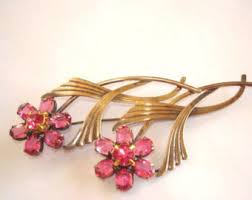
So my next step was to look see if I could find any of the jewelry for sale.  Both Ebay.com and Etsy.com had a number of pieces. many of which I would be more than happy to wear.  There were lots of pins,


some bracelets, especially scarab bracelets,

and necklaces or pendants.


I was curious to know what kind of jewelry W. E. Richards was making now, so I called their main office in Attleboro.  I discovered that the company sells midrange high quality women's jewelry, typically made with 14 carat gold and colored stones.  The jewelry is sold only through jewlery stores.


I think it may be time for me to shop.

Tuesday, July 4, 2017

#108--Abel Richards's Secret Mission in the Revolutionary War


The Fourth of July always reminds me of the fight for independence and the Revolutionary War.  So for this week, I decided that I would blog about an ancestor who fought in that war and whom I did not know much about.  I have previously blogged about Abiathar Richards, Sr. and Abiathar Richards, Jr.—my grandfathers, who fought, so I needed to find someone else.  I did not take long for me to find Abel Richards, the younger brother of Abiathar, Sr.

Abel was listed in the Massachusetts Soldiers and Sailors in the Revolutionary War on Ancestry and as a Daughters of the Revolutionary War patriot.  Those are very brief summaries of his service.  He served for nine days as a private in Captain Ellis Company on the Lexington Alarm on April 19, 1775 and served 2 more days at the same time with Captain David Fairbanks.  In addition, he served 4 days at Dorchester Heights, when the company marched to Roxbury in March of 1776.  In June 1776, he was commissioned a Captain of the 6th Company, 1st Suffolk Regiment; he served 1 month and 7 days on a “secret” expedition to Rhode Island.  Two years later, in March, 1778, he captained a company in Col McIntosh’s regiment, and served until April 19, 1778 at Roxbury and Boston.

I always find those summaries both helpful and frustrating.  Helpful because you get information and frustrating, because there is not much information.  So I was pleased to find out that Fold3.org had made its Revolutionary Wary files searchable for free from July 1 to the 15.  Looking for any information on Abel, I found that his wife, Mary, had applied for a widow’s pension and that in the pension file, were several affidavits about his service from men that had served with him.  The one I found most helpful was the one which shed some light on that secret mission.  Joshua Whiting stated “Captain Abel Richards raised or mustered a company of soldiers of nearly 100 men and marched from said Dedham by way of Taunton to Tiverton or Little Compton,in the State of Rhode Island, and and in this expedition did perform military service five or six weeks and were then discharged and returned to Dedham…”  From that description, I am not sure why it was described as "secret."

 Abel was born in Dedham, Massachusetts in 1738.  His parents were John and Abigail (Avery) Richards.  In 1764 Abel married Hannah Newell and with her had five children.  After her death in 1794, Abel married Mary White. Abel died on January 18, 1832 at the age of 94 and was buried Westwod Cemetery in Westwood.Massachusetts.

As always, I would have some questions for Abel Richards.  First, I would like to know about that “secret” mission, which when Joshua Whiting described it.  Just what did they do?  Why did Whiting think it was "secret"?  I also would like a first-hand account of his participation in the Lexington Alarm—how did he hear about the British coming?  How did he get there?  Who else went?