Welcome to my genealogy blog. Ancestors I Wish I Knew is a combination of genealogical information and stories about individuals in my family tree. The focus is on those from my Cochrane, Eitelbach, Merrett, Minarcik and Richards lines and their descendants.

Sunday, June 23, 2019

#186--Thomas Cochrane--A Legend in his Own Time


Thomas Cochrane, Lord Dundonald


If you have seen the movie Master and Commander, or read of the any of the novels featuring Horatio Hornblower or Jack Aubry, you have read about my ancestor, Thomas Alexander Cochrane.  His navel exploits were legendary.  Family lore was that he was one of my grandmother’s uncles.  As with many family stories, it contained a kernel of truth—Thomas Alexander Cochrane was her cousin. 

Ship Speedy
Thomas Cochrane was born at Annsfield, near Hamilton in Scotland, the son of Archibald Cochrane, 9th Earl of Dundonald and Anne Gilchrist. He spent his childhood in Annsfield .  At the age of 18, Thomas joined the British Navy.  He served on several ships, before becoming the captain of RN sloop, HMS Speedy. Within a year Cochrane had captured fifty ships, 122 guns and 534 prisoners. However, he was not finished; appointed Post-Captain he cruised along the French and Spanish coasts capturing so many ships that Napoleon called him “le loup des mers” or the Sea Wolf.  For his exploits, he was made an Knight of the Order of the Bath. 
Lord Cochrane

Cochrane’s career was not without controversy.  He was elected to the House of Commons as a Member of Parliament in 1806 and used his position to rally against the naval corruption, the war with France and several well established individuals.  Further controversy involved his marrying Kitty Barnes, who was 20 years younger than he was.  If all that was not enough, he was engaged in the Great Stock Exchange Fraud along with his uncle, Andrew Cochrane-Johnstone in which they announced that Napoleon was dead.  That sent the market crashing. Cochrane was tried, sentenced to a year in prison and fined of 1000 pounds, ejected from the Navy and stripped of his knighthood.  However, he was immediately re-elected to parliament. 

In 1817, Cochrane with his family moved to South America where he commanded in order, the Chilean, Brazilian navies in their fight for independence and then moved to Greece to command their Navy.  

After being pardoned for his role in the Great Stock Market Fraud, Thomas returned to the Royal Navy as a Rear Admiral.  Queen Victoria restored his knighthood.  In 1847 he became Commander-in-Chief of the North American and West Indies Station.  In 1854 he was given the honorary rank of Rear Admiral of the United Kingdom. 

Cochrane died in 1860, and is buried in the center aisle in Westminster Abbey in London. His epitaph reads:


'Here rests in his 85th year Thomas Cochrane Tenth Earl of Dundonald of Paisley and of Ochiltree in the Peerage of Scotland Marquess of Marenham in the Empire of Brazil GCB and Admiral of the Fleet who by his confidence and genius his science and extraordinary daring inspired by his heroic exertion in the cause of freedom and his splended services alike to his own country, Greece, Brazil, Chile and Peru achieved a name illustrious throughout the world for courage, patriotism and chivalry. Born Dec 14 1775. Died Oct 31 1860'

Each year the Chilean Navy places a wreath on his grave.  


Grave --Westminister Abbey


Monday, June 17, 2019

#185-Earliest Ancestor--Fulk, Were You Really Rude?


The blog theme for this week is “Who is your earliest ancestor?”  Now I can go way, way back to the Middle Ages with documentation.  When I first started doing genealogy, I spent a week at the New England and Historic and Genealogical Society on one of their research trips.  One afternoon I worked with Gary Boyd Roberts, who looked at my Cochrane Tree and decided that he could take it back a couple of generations.  Several hours later that tree had gone from the 1700’s to the 1312, the birth of my 24th grandfather, King Edward III, Plantagenet.  I was amazed and excited.  I had no idea of that relationship and it opened up a whole new world to explore.  There is a great deal written about the Plantagenets and most of it is very well researched. 

So when I got home and had a little time, I decided to see how far back I could take that Plantagenet line.  It was not very hard.  With documentation, I could go back to Geoffrey Gastinois, II born in 1006  He is either my 24 or 25 great grandfather.  In 1035, he married Ermengarde-Blanche of Anjou, daughter of Fulk III Nerra. They were the founders of the House of Plantagenet.


Geoffrey and Ermegarde had three children:  Hildegarde, Geoffrey III of Anjou and Fulk IV, Count of Anjou (Also known as Fulk the Rude).  Geoffrey III inherited Anjou from his Uncle, Geoffrey Martel.  However, Fulk took Anjou by force, captured his brother and imprisoned him.  Because of their conflict Fulk lost a considerable amount of territory and was forced to give the Gâtinais, part of his land,  to King Philip I of France.   Fulk spent the rest of his reign as count trying to regain control of his barons and all the lost lands.

Geoffrey died sometime about 1046 and Fulk about 1109.

I would love to talk to Fulk, the Rude and ask him how he got that name.  I have read that it could also be translated as quarrelsome or surly. 

Monday, June 10, 2019

#184--Dear Diary


Dear Diary—
     I have been doing genealogy for over 20 years and I wanted to tell you what I wish I knew when I started out.  In those days, genealogy was not as popular pastime and there were not many ways to learn.  So I really taught myself.  Here is what I wish I knew then:
1. Start out by talking to your relatives to find out what they know.  Realize that some of that information is probably not correct.
2. Create separate trees for different lines.  That makes finding people easier. A tree with 600 people is easier to manage than one with 10,000.
3. Document every fact that you use.  While you think you will remember where it came from, you will not.
4. Develop a system for keeping track of the papers.  For example, use a notebook for each line or use a folder system on a flash drive.
5. Use a variety of different online resources.  Many of them have different information on them.
6. Be very careful and skeptical of information in family trees that are on line.  You have no idea where that information came from and it may or may not be correct.  Think of it as a clues to be followed.
7. Local histories contain a great deal of valuable information about what happened while your ancestors lived there and may have biographies of them.
8. Visit local history/genealogy libraries.  Talk to the staff, they are a wealth of information
9. If you can, go on research trips with a group, e.g. New England Historic and Genealogical Society. There should be lectures, research assistance, and a chance to talk to other people doing genealogical research.
10. Join at least one national genealogy group and the local societies where you have ancestors.  Good access to local information.
11. Everyone has a brick wall.  Work on it periodically, but do not obsess over it.
12. Connect with other people, probably cousins of some kind, who are working on your lines.  It is fun to work together.

Good Luck.

Mary

Wednesday, June 5, 2019

#183--Namesakes--Two Abiathar Richards


It is not unusual to find that son is named after his father. In my family tree I have two Abiathar Richards. They are my fourth and third great grandfathers.  Abiathar Richards Sr. was born in Dedham Massachusetts in 1730.  His parents were John and Abigail (Avery) Richards.  Abiathar married his cousin Elizabeth Richards on May 21, 1753.  Abiathar Richards, Jr., his oldest son, was born on April 7, 1754, in Dedham, Massachusetts. Abiathar Richards, Jr. married Elizabeth Smith on April 12, 1782.

As I looked at these two individuals, I was struck by how similar they were. Both lived in Dedham their entire lives.   Both married women named Elizabeth.  Both had large families.  Abiathar Sr. had 9 children while his son had 12.  Both were farmers in Dedham

Both served in the Revolutionary War.  Abiathar Richards, Sr. participated several times. First, he was part of Captain Joseph Lewis 1st Dedham Company and for four day guarded the cannons on Dorchester Heights. Abiathar Richard’s second service was closer to home, in the neighboring town of Roxbury.    In colonial times, Boston was located on a peninsula with the only land route into Boston, going through Roxbury.  To protect the city, troops were stationed in Roxbury.  For 15 days beginning on March 23, 1778 Abiathar Richards served in Captain Abel Richards’s company at Roxbury and Boston.

Abiathar’s last enlistment was on July 21, 1780.  At that time he became part of Captain Moses Bullard’s Company, Col. Ebenezer Thayer’s Regiment, which was stationed at Rhode Island to reinforce the Continental Army.  His service there was 2 months and 24 days.

Abiathar Richards, Jr. also served, but his service was much shorter.  Abiathar Richards, Jr. was a Private in Captain Aaron Fuller’s Company, which marched on the alarm of April 19, 1775.  The company was from Dedham, Massachusetts and served for 2 day.

After their service was completed each returned to farming. In addition, Abiathar Richards also was in a partnership with Calvin Whiting and Reuben Newell, selling Indian and English pottery.

Abiathar Richards died on September 30, 1803, in Dedham, Massachusetts, when he was 73 years old. His son died on July 10, 1835.  Both are buried in the Village Cemetery.


Tuesday, May 28, 2019

#182--King's Chapel Burial Ground and William Avery


Grave Yard--King's Chapel Boston


Several years ago, I was in Boston, which gave me the chance to go visit the grave of another of my ancestors, William Avery. William is my 5th great grandfather.

William Avery was born in 1622, in Barkham, Berkshire, England, the son of Christopher and Margery (Stephens), Avery.  William married Margaret Allright.  They, together with their three children:  Mary, William, and Robert, came in 1650 to the Massachusetts Colony and settled in Dedham, Massachusetts.   He and his wife were admitted to the church on February 16, 1650.  He was a sergeant in the Dedham militia as well as the Deputy to the General Court.  He was a member of the Ancient Artillery Company.

Margaret Avery died on September 28, 1678.  Shortly thereafter, William moved to Boston and married Maria (Woodmansey) Tappin, who son ran a book shop.  William took over the  store and added an apothecary department to it. Despite his move, in 1680 the Dedham Town Records state  that “Capt. Daniel Fisher and Ensign Fuller report that Dr. William Avery, now of Boston, but formerly of the Dedham Church, out of entire love of  his Church and Town, freely give into their hands, sixty  pounds, for a Latin school.
King's Chapel

William died on the 18th of March 1686.  He is buried in the burial ground of King’s Chapel in Boston.

I had no trouble finding the burial grounds as it is part of the Freedom Trial.  The burial ground was started in 1630 and was Boston’s first graveyard.  According to the National Park Service, there are 505 headstones, 78 tombs, and 59 footstones; however, more than 1000 people are buried there.   A very helpful Park Ranger (King’s Chapel is a national park) showed me a map of the graves and noted that the headstones had been moved at some point so while William Avery is buried there, he probably is not buried beneath his gravestone.  I had no trouble find William’s grave as it is directly to the right to the gate to the graveyard.

Gravestone of William Avery

His gravestone reads:


Here lyeth Bvried
the body of
WILLIAM AVEARY
aged abovt 65 years
died Mearch the 18th
1 6 8 6

Friday, May 17, 2019

#181--Abiathar Richards, Jr.--Fighting for Freedom


Several years ago I blogged about  Abiathar Richards, Sr. and his role in the Revolutionary War.  However, he was not the only person in that household that fought for freedom.  His oldest son, Abiathar Richards, Jr. also served briefly.  Abiathar, Jr. is my 3nd great grandfather and the subject of this week’s blog. whose theme is military.

                Abiathar Richards, Jr. was born on April 7, 1754.  His parents were Abiathar Richards, Sr. and Elizabeth (Richards) Richards.  He married Elizabeth Smith on April 12, 1782.  Abiathar and Elizabeth had eleven children.

                I did not know much about Abiathar, Jr.’s service, but  found in the Massachusetts Soldiers and Sailors in the Revolutionary War,  that Abiathar Richards, Jr. was a Private in Captain Aaron Fuller’s 
Company, which marched on the alarm of April 19, 1775.  The company was from Dedham, Massachusetts and served for 2 day.  That was helpful, but I still did not know that much about what that company actually did.  Fortunately, I was able to find a description of their involvement in Dedham, 1635-1890:  Examples of things past.


          “A little after 9:00 a.m. on the morning of April 19, a rider on an (inevitably) lathered horse galloped down Dedham High Street from the direction of Needham, and reined in at Samuel Dexter’s front gate.  Flinging himself off the horse and rushing up the walk, he met Dexter at his door, spouting forth his message of bloodshed and conflict at Lexington. ..As units or fragments of larger military contingents, Dedham men assembled and march for the scene of the engagement—89 men from the First Parish under Captain Aaron Fuller and George Gould….[At Menotony (now Arlington)] some of the men, joining with units from Needham and Lynn, ranged along a hill on the south side of the road, where they had a clear view of the approach from Lexington, and where they could expect a measure of protection from a stone wall that stretched uphill from the Jason Russell house.  A British flanking party surprised them and drove them back toward the house, trapping them between the flankers and the main body of troops in the road and virtually annihilated them.  Elias Haven of Captain Battle’s Company died there, along with nine men from other towns, (Hanson, p.155).


So now I know a little more about Abiathar, Jr.’s 2 days of service in the Revolutionary War.  Exactly where he was and what he did during the battle at Menotony I do not know.  So if I could talk to him, I would ask them those questions. 

Tuesday, May 14, 2019

#180--Jane Mears Calvin--Female Farmer


The theme for this week is nature.  I have many relatives who were farmers; the vast majority of them were men; however, a couple were women.  So my blog this week focuses on Jane Mears Calvin, who ran the family farm after her husband, David died. 

Jane Mears, my 3rd great aunt, was born on June 20, 1803, to Elizabeth and David Mears in Adams (now Brown) County, Ohio.  On June 20 1803.  When Jane was 17 years old, she married Jesse Stephenson in Brown, Ohio, on August 10, 1820.  Jane and Jesse had four children, three sons and one daughter.  Jesse died on February 1828 in Brown, Ohio.  About1830 Jane moved to Edgar County, Illinois. 

Jane then married David Calvin in Edgar, Illinois, on June 2, 1833. They had five children: one son and four daughters.  Her husband David passed away on October 4, 1845, in Edgar, Illinois, at the age of 44. Jane Mears Calvin died on October 29, 1878, in Edgar, Illinois, when she was 75 years old.

The Illinois Public Domain Land Tract Sales and the private land sales indicate that David bought land in 15 Township North, 11 Range West.  The map of Edgar County shows that the land would have been in Brouletts Creek.  I assume that was where they lived and farmed. 

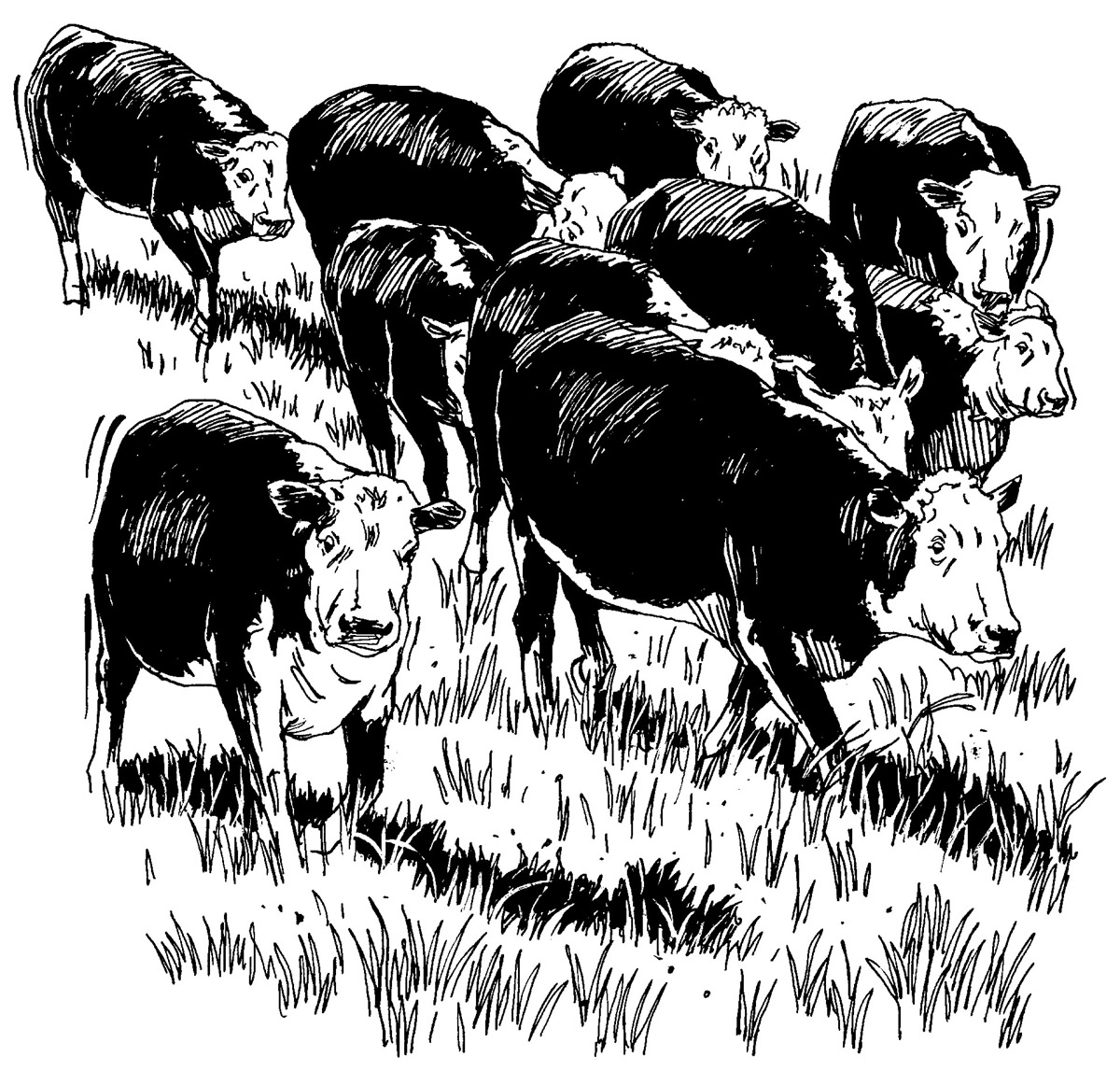
The 1860 Agricultural Census Schedule lists Jane Calvin as the owner of a farm.  The farm consisted of 107 improved acres and 147 unimproved with a value of $3800.  $100 was the value of the machinery and farm implements. Jane had 9 horses, 6 milch cows, 7 other cattle, 25 sheep and 20 swine.  The livestock was valued at $1050.  The farm produced 48 bushels of wheat, 1000 bushels of Indian corn and 85 pounds of wool. The farm produced 30 bushels of potatoes, 200 pounds of butter, 5 tons of hay, and 75 gallons of molasses.  The animals that were slaughtered during the year were worth $50. When I looked at the other farms which were listed, Jane’s farm was pretty typical, not the largest, not the smallest, just kind of typical.

I would love to talk o Jane and find out how she ran the farm.  Did her children do most of the work?  Did she hire people to help her? How did she learn to manage the farm?  Did she make changes to the farm as time when on?  Her sister-in-law Sarah Ann Hannah Mitchell also ran the family farm after her husband died in 1857 (See blog on the right side of this page).  I am wondering since Jane had been running her farm for some time, she provided any advice to Sarah.