Welcome to my genealogy blog. Ancestors I Wish I Knew is a combination of genealogical information and stories about individuals in my family tree. The focus is on those from my Cochrane, Eitelbach, Merrett, Minarcik and Richards lines and their descendants.

Monday, September 16, 2019

#196 So Many John Hannahs


This week’s theme is mistakes.  Errors are easy to make in genealogy, particularly when you do not have a lot of information or when a number of people have the same name.

I have 11 John Hannah’s in my tree.  I also have several with a different first name, but John as their middle name, e.g. John Hannah Turner. In some way or another they are all related, often lived in the same area and farmed.  The ones I am most interested in are John M. Hannah and John Wesley Hannah, my great great and great grandfathers.

It was easy for me to mix them up.  So I had to come up with ways to separate them. 
John Wesley Hannah with his daughters, Tim and Toots

One way to keep them straight is to use their middle names, if they have them.  So John Gates Hannah, John Gray Lawrence Hannah,  and John Bayard Hannah are easy to keep straight as long as they are referred to  with their middle names.  If not, dates of birth can distinguish them.  The dates of birth range from 1799 (John M. Hannah) to John Clifford Hannah (1919).  Location also helps.  The earlier John Hannahs tended to live in Brown County, Ohio or Edgar County, Illinois.  As time passed, some moved to places like Missouri or Colorado.  So if a John Hannah turns up in California, I will check him out, but can be pretty sure he is not one of mine.

The lesson I learned from all these John Hannah’s is be careful and check to make sure you have the correct one.

Sunday, September 8, 2019

#195-- Richards Hannah Goes Back to School


Poly Prep


This week’s theme is schools.  How appropriate as most students are now back at school.  I have previous blogged about my grandfather attending Wentworth Academy and Dickinson College as well as my great Aunt going to Baird.  So I decided I would blog about Poly Prep County Day School (Poly), where my father was a student.

Poly was started in 1854 at 99 Livingston Street, Brooklyn.  The academic program was very strong and equal to the programs at elite boarding schools. A variety of extracurricular activities evolved:  a newspaper, drama society, debate. Students wanted more athletic opportunities.  In 1916 part of the Dyker Meadows Golf Course was purchased and the school was incorporated as the Polytechnic Preparatory Country Day School.  350 students arrived in 1917.  Students stayed after school to engaged in after school activities, typically sports.  Poly was all boys until 1979, when girls were admitted.

Richards Hannah in Lacrosse Sweater
In the family that does not throw out anything of sentimental value, I have the yearbook, The Polyglot, from my father’s senior year.  It is a pretty typical yearbook—pictures of students by class, pictures of the faculty,  pictures of various athletic teams, clubs, etc.

I knew that my father played hockey and lacrosse at Poly, but I learned that he was also on the soccer team, and was its captain.


He was  Vice President of the Oasis Society.  According to the Poly website, the Oasis Society “recognizes leadership and accomplishment that benefit our school, aiming to promote school spirit and service to the school community.” In addition, he was in charge of refreshments for the Senior Dance.

Oasis Society--R.W. Hannah--Second Row Second from Left


When talking about his time at Poly, my father tended to talk about the sports he was involved in and his friends.  I wish I had asked him more about the academic side of his experiences there.


Lacrosse Team  R. W. Hannah-First row third from left.


Monday, September 2, 2019

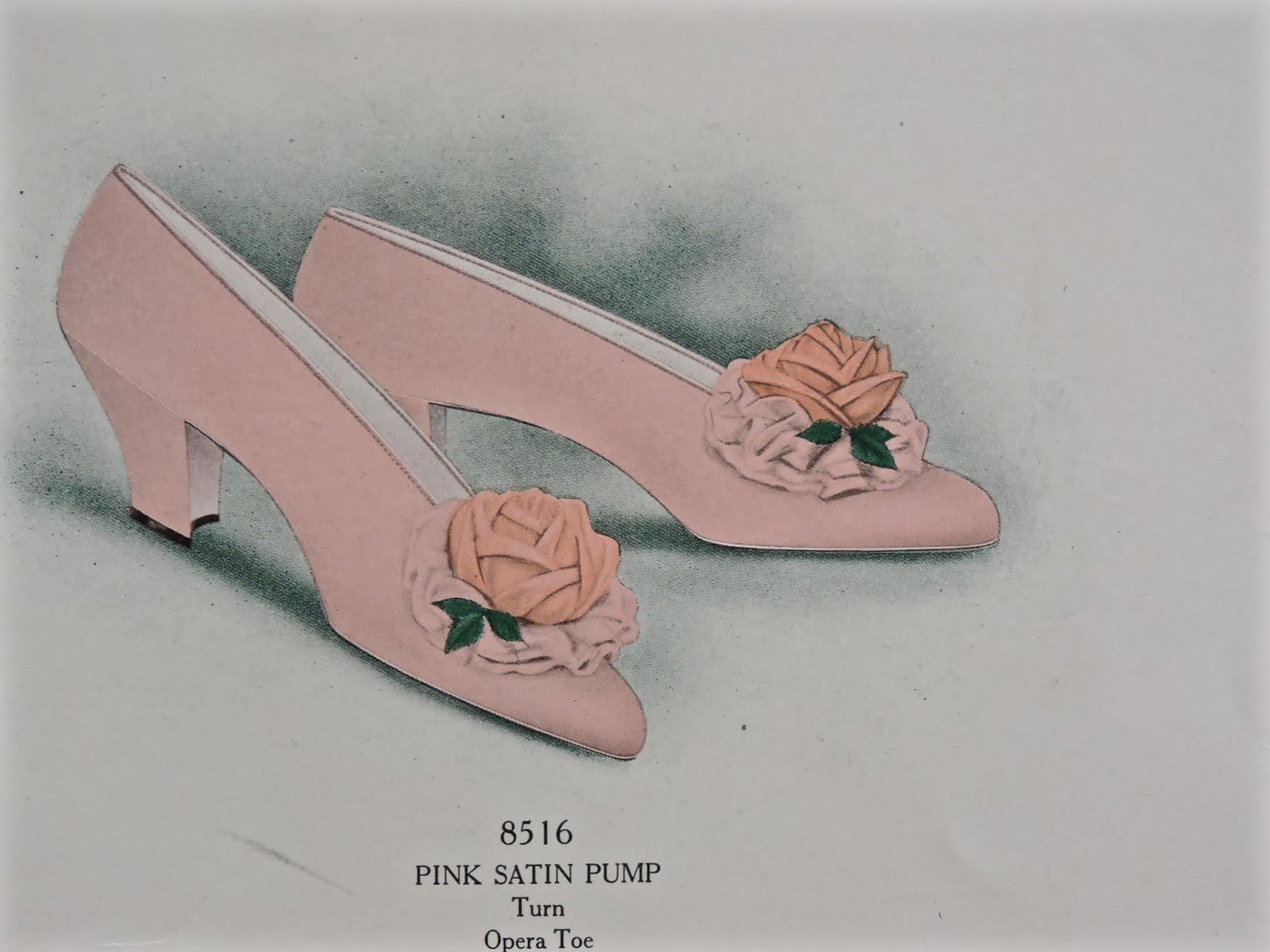
#194--Shoes and More Shoes


My grandfather, William D. Hannah was in the shoe business.  He had a shoe factory in 
W.D. Hannah Shoe Factory--Newburyport, Massachusetts.
Newburyport, Massachusetts and another in Dobbs Ferry, New York in the early 20th century.  He also had a showroom on Duane Street in New York City.

 At that time, the way to advertise was to send catalogs or flyers to businesses.  I am fortunate to have  several of his catalogs.  Some were fairly simple and others were rather elaborate.

 Here are a couple of my favorites:


I love to look at the shoes in the catalogs. There are shoes for women as
well as boots. I would love to wear either of these pink shoes.


Just look at all the colors those shoes come in.


I am not sure whether this is a shoe or a boot.  I love the buttons, but think it would take me a long
time to get them buttoned up.  Want to know how much they cost?  See that number at the button.  That is the price, but you have to read it backward.  The shoe/boot costs $1.60.


Wednesday, August 21, 2019

#193 Tragedy--Shoot Out


This week's theme is tragedy.  Bad things happen in all families, but this is a most interesting one from my family.  

Harlan Turner, my great aunt's husband certainly was involved a a tragedy .   I did not know much about him, except that he married my Aunt Gert Hannah in Butler, Missouri on April 4, 1890.   Then they divorced 9 years later.

Harlan was born Morgan County, Kentucky on February 27, 1857 to James and Elizabeth (Trimble) Turner. The 1860 and 1870 census describe him as living at home with his parents in Kentucky.  In 1880 Harlan is living in Valley, Linn, Kansas.  He is described as a farmer and a partner in the farm. When he arrived in Butler, Missouri is a mystery to me.  However, I got more information about him from the Butler newspaper.

Imagine my surprise to read that he was involved in a gun fight in a saloon  in Butler. Compared to
the size of most of the articles in the paper, this was a much longer article so I suspect it was a big story in Butler.  As I read the article, this is what seems to have happened.  Harlan Turner and his friend, J. W. McVeigh had spent most of the day from noon to early evening drinking in the Goose Saloon.  About 7 o’clock they began to hit each other over the head and in the face with their hats.  To avoid further trouble, the bartender closed the bar, and Turner and McVeight left, and went their separate ways.

Later in the evening they both returned and their gun fight ensured.  The bartender, Robert Plummer, described the incident as follows:


Harlan Turner was tried in Circuit Court in Butler .  A variety of witness testified as   
to what they had seen and Turner testified indicating that he shot McVeigh in self-defense. After describing an verbal interaction with McVeigh, Turner said the following:


After defense rested, the jury began its deliberations about 8 o'clock in the evening and returned a verdict of not guilty 15 minutes later.  


Friday, August 16, 2019

#192--Comedy


Comedy is this week’s theme.  When I think of comedy I think of clowns and when I think of clowns, I remember that I have two relatives who worked as clowns when they were children.

Their father, James Willey  (1850-1918) changed his name to Signor Montanio.  James worked as an acrobat, tight- rope walker, and a trapeze  artist. He also ran circuses--primarily, the Great New York Circus and the Great Mexican Circus.   He married Josephine Greenwalk (1860--1899), and they had four children--Harry (1873-1947), Perry (1880-1942), Minnie, and Charlotte.  The boys worked in the shows as clowns and acrobats and their mother had a musical act. 

Local newspapers often reported that the circus was coming or reported on the performance.  Those clippings gave me some insight into what the boys did. According to this article, sometimes they worked as acrobats or trapeze artists.


At other times, they did sketches.


While the article above describes them as twins, they were not.

I wonder what Harry and Perry looked like and was thrilled to find these two pictures of them.


From tracking the route of their circus--The Great New York Show or the Great Mexican Show, the boys worked until 1893.  After that, various newspaper articles show them working as cowboys, often in rodeos.  

I would love to talk to them and find out exactly what they did, what it was like to travel with a circus, and their lives as cowboys.  

Wednesday, August 7, 2019

#191--Sisters--Staying Together


The theme for this week is sisters. My great grandmother, Charity Mears,  had five sisters, they are part of my ancestry tree that I call the tribe and that I have written about before.  I think of them as a tribe because they tended to stay together.

This time I want to look at who they married and see if there were relationships among their husbands.

So the first thing I needed was a listing of the sisters and brothers and their spouses, which I obtained from an earlier blog.

 Mary Mears ((1786-1873)—Lemuel Boyle Sayer
Elizabeth Mears (1796—1880)—Jonathan Shreve
Catherine Mears (1799-1888)—Robert Legate (1802—1822)  and  Israel Donnelson Sayre (1807-1849)
Nancy Mears (1801-1883)—George Newell (1798-1875)
Jane Mears (1803-1878)—Jesse Stephenson (1804—1828)and David Calvin (1800/1810—1845)
Charity Mears (1806—1842)—John M. Hannah (1799-1842)
Sarah Jane Mears (1808-1899)-- George Fisher (1807-190)
William Mears (1799-1873)--Sarah Newell (180--1873).


There are several last names in common.  Were they related? I found that Lemual Boyle Sayres and Israel Sayers were brothers.  They were born in Brown County Ohio to Dennis and Hester (Donaldson) Sayres. Lemuel Remained in Brown County, while Israel moved to Edgar County, Illinois.

The Newells--George and Sarah--were brother and sister.  They were both born in Brown County.  Their parents were William Morris and Sarah (Paul) Newell.  Goerge and Nancy moved to Deer Park Illinois.  William and Sarah lived in several places in Indiana and then Ripley, Iowa.

I do know know how common it was for two sisters to marry two brothers.  I think it might have not been unusual in areas where the population was not large and therefore, there would have not been many choices in terms of spouses. I would like to talk to them to find how why these marrages took place. 

Friday, August 2, 2019

#190-- Four Brothers in the Jewelry Business


The theme for this week’s blog is brothers. I was really excited.  My great grandparents, Louis and Maria Eitelbach has six children—all boys.  They lived in Hagen, Germany until 1896 when they, along with their four youngest children—Walter, Louis, Maxmillian and William—came to the United States.  They settled in Brooklyn, New York at 1287 Greene Street.  After their arrival, Maria had two more children—Harry and Frank.

Four of the brothers—Walter, Louis, Harry, and Frank-- went into the jewelry business in New York City.  Under the name of Eitelbach Brothers, they designed, manufactured, and sold fine jewelry.  I am not sure, but I believe that Louis designed the jewelry, Harry and Frank manufactured it and Walter sold it.  I remember going to 2 West 47th Street, New York City right off Fifth Avenue and seeing them make jewelry.


The other two brothers took different paths.  Maxmillian went into the mortgage business and became assistant manager of the New York Title and Mortgage Company.  There is little information about William, however, in the census, he describes his occupation once as a machinist and another time as a jewelry manufacturer.


I really wish I had talked to my grandfather about the jewelry business.  I also wish I had been able to spend time with my uncles.